






Etat civil and foyer fiscal
Everyone completes these
First screen of main declaration / Page 1 of paper 2042
You may be filling this in in one of three possible ways, each presented slightly differently:
If you are declaring for the first time you will be using a blank, standard, 2042 form, which can be found with a search at impots.gouv.fr. You may also be using this in future years if for some reason you declared online previously but are not able to do so this time.
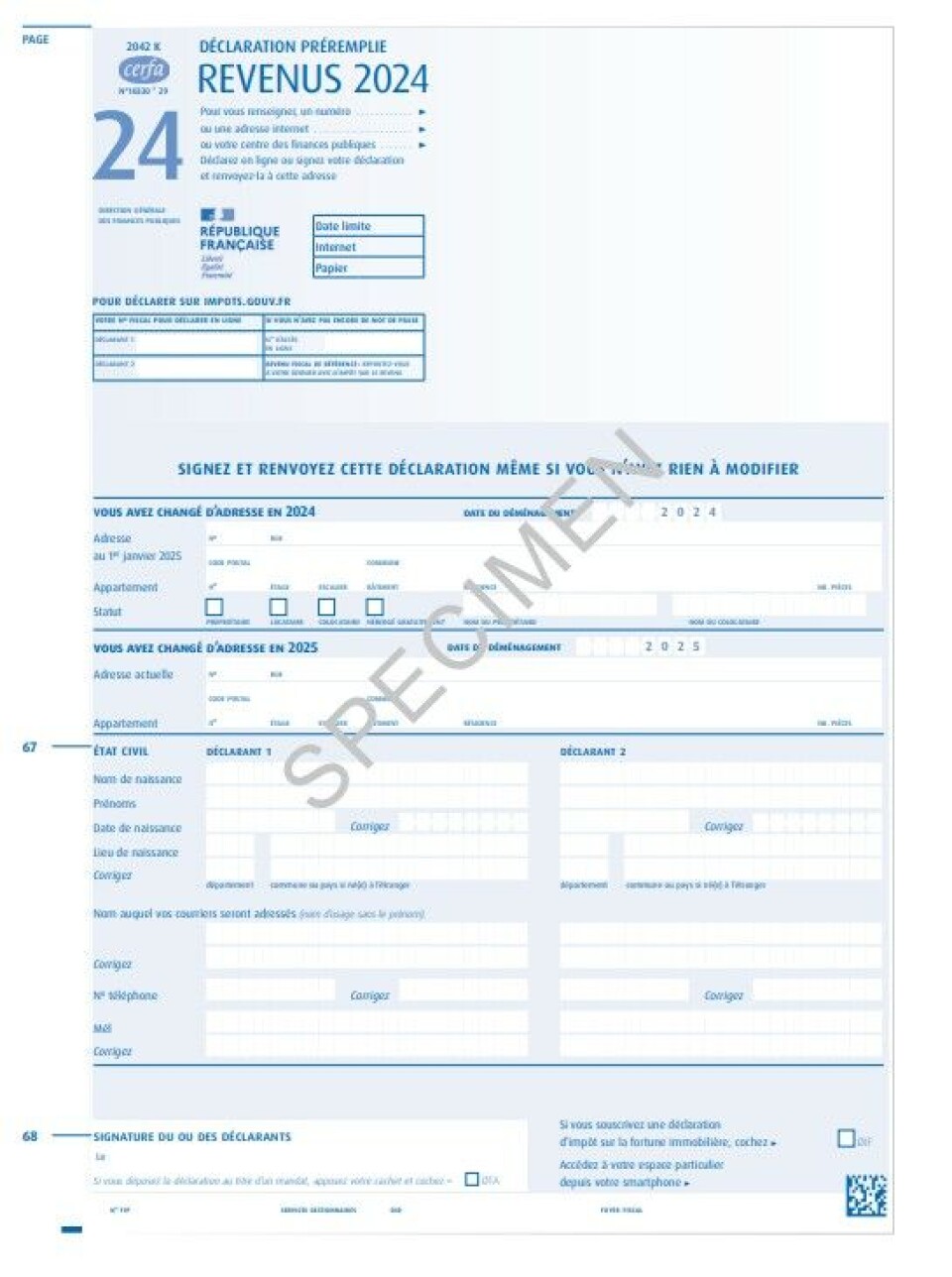
If declaring on paper in a subsequent year you should be sent a version prefilled with the main known details about you: 2042K.
Most people declaring for the second time, or further times, will be using the online Déclaration principale.
Note that (married, Pacsed or civil partner) couples can declare online via the personal space of either partner. The details of both should appear.
The two members of a couple are identified as déclarant 1 and déclarant 2, with the traditional convention being that the man in a couple would be déclarant 1 (this is not necessarily the case).
If someone is already known to the tax system (eg. property owner or past resident) it makes sense for that person to be déclarant 1. You could, otherwise, choose the person who is most likely to deal with admin such as the annual tax declaration or, if relevant, the person who is the main breadwinner.
Many lines in the declaration are in a multiple-column format, for the first and second declarer and then any adult dependents who live in their tax household.
After the preliminaries, the first part of this section concerns personal details, address, and family make-up.
Note that the forms include a box (0TA) to be ticked in case of someone completing the form on someone else’s behalf, under a mandate. This mostly applies to accountants. The paper forms ask the person to add their professional stamp next to this in this case.
If declaring on paper, a cross, not a tick, is the French convention for selecting boxes.
Blank 2042
If declaring for the first time, do not forget to cross the box at the top of the form to confirm this. You will need to attach with your declaration a copy of an ID document.
If you have declared before you are asked to insert:
Numéro FIP: This is an identification number for your tax household, that can be found on your last avis d’impôt income tax statement
Numéro fiscal: Your own personal tax number, also found on the avis d’impôt
Numéro fiscal du conjoint: Your spouse/partner’s tax number (if you have one).
The rest of the form is similar to the 2042K and online form, but note that as you are not known to the tax office yet you are asked at the start to insert your full address as of January 1, 2026, whether you rent or own, flat/houseshare or live free of charge and, if relevant, landlord / and flatmate details.
Signing paper forms
The first page of the 2042 is also the place to sign and date paper forms, including adding the name of the town/village where you signed. Both partners in a couple should normally sign, but if only one does so, the declaration is still binding on both.
Etat civil
The sections for nom and adresse are straightforward, but remember that nom is surname, not first name.
France takes birth/maiden names (nom de naissance) as the default, but there is an option to give another surname (nom auquel vos courriers seront adressés), such as your spouse’s surname, if you wish the tax office to refer to you by this.
Your first name (and if relevant second, third, etc., name) goes under prénoms.
When asked for your department of birth, put 99 if it was outside France and in the section for the commune, you insert the country if it was abroad (e.g., Royaume-Uni or Etats-Unis).
Address
Read the address sections carefully, to make sure you fill in the exact information asked for.
On the paper forms this includes, if you moved in the course of 2025, giving the former address and date of moving, and if you changed address in the course of 2026, the date of the move and your current address.
The online form should be prefilled with your address on January 1, 2026. If relevant, however, select the box: ‘This is not my address on January 1, 2026 because I moved in 2025’ or ‘I moved in 2026’. If you select one of these, another section will be provided to complete further details.
In the case of a moving house you will be asked for full details, including (for those living in flats) apartment number, floor, staircase number/letter or building number/letter, and name of residential complex. If you are currently living at an address previously unknown to the tax office you are also asked to state if you are owner, renter, part of a flat/house-sharing arrangement, or hosted free of charge.
The image below shows the paper 2042K that is sent to people who have declared previously by paper.
Second screen of main declaration / page 2 of paper 2042
This relates to your family situation, which is important because the number of dependants you have affects the amount of tax you pay due to the family quotient ‘parts’ system (see the tax bands sections in chapter 5 for more on this).
Situation du foyer fiscal en 2025 is for you to mark your marital status. British civil partners should cross the pacsé(e)s box as civil partnerships are seen as equivalent to this.
If you married or became pacsé in 2025, insert the date of the marriage/pacs and your partner’s tax number (numéro fiscal). You can make a joint declaration for the whole year or select a box to choose instead to make individual declarations this year.
If you were divorced or separated from a spouse/partner, insert the date in the relevant box. This is also the section for declaring a partner’s death in 2025.
The following boxes relate to situations which increase the family quotient parts.
You gain an extra half part if you were living alone on January 1, 2025, with no dependants but have or had (because they have now died) adult children whom you previously raised alone for at least five years. If you were divorced or separated in 2025, it is your situation on December 31, 2025, that counts.
Beneficiaries of a French military or work accident invalidity pension at a level of at least 40% or disabled people with a carte d’invalidité at 80%+ disability or the Carte Mobilité Inclusion – Invalidité (or whose spouse qualifies, or qualified if they died in 2025) are entitled to an extra half part.
There are similar boxes for over-74s (as of December 31, 2025) with French military or war victims’ pensions or war veterans’ cards (or for widow/ers of such people) or for French war widows.
The parent isolé section should be selected by those who were unmarried, divorced, or separated and living alone (i.e., without any live-in partner) with dependant children or a dependent disabled adult on January 1, 2025 (or December 31, 2025, if divorced or separated in 2025).
Personnes à charge is to note your (financial) dependants. You can count as such all under-18s that you and your partner look after. You can also count disabled children of any age if they cannot look after themselves alone and are financially dependent on you, whether or not they have a Carte Mobilité Inclusion disability card with the invalidité heading, which allows an extra half part.
This includes children who live with you in alternate residence with another adult as well as people living with you, such as elderly parents, who have an invalidité disability card.
You are asked to total the number of unmarried under-18s who live with you, plus disabled children of any age as well as giving the total of disabled children meeting the invalidité card criteria. Birth years are required as well as further details for each child.
Beneath this is a section for completing the same information about children who live with you in alternate residence.
At the bottom of the section are lines for giving the number of disabled adults, their birth years, and their surname, first name, and date and place of birth.
The Rattachement section is for adult or married children ‘attached’ to your household (see chapter 7, 'Lowerings linked to your adult children').
At the bottom of page 2 of the paper 2042 you will find a notes section (Informations) where you can make additional comments, should you wish. If declaring online there is no similar section and so the only option to make a comment to the tax office as part of the declaration is to click at the end of section 3 to make a mention expresse.
If declaring on paper and the Informations box is too small to include everything, use a blank sheet of A4 and staple it to the back of the form, adding a note in Informations such as: voir feuille de papier supplémentaire agrafée à ma déclaration (see extra sheet of paper stapled to my declaration).
This box may be followed by an extra section for inserting your bank details (e.g., for tax credit money or for direct debits related to tax-at-source). Otherwise, if you are making a paper declaration you should attach a RIB bank details document.