






property
French notaire data reveals where house prices are rising - and falling
Chartres, Orléans and Lyon saw prices go up as Brest, Dijon and Bordeaux all experienced a drop
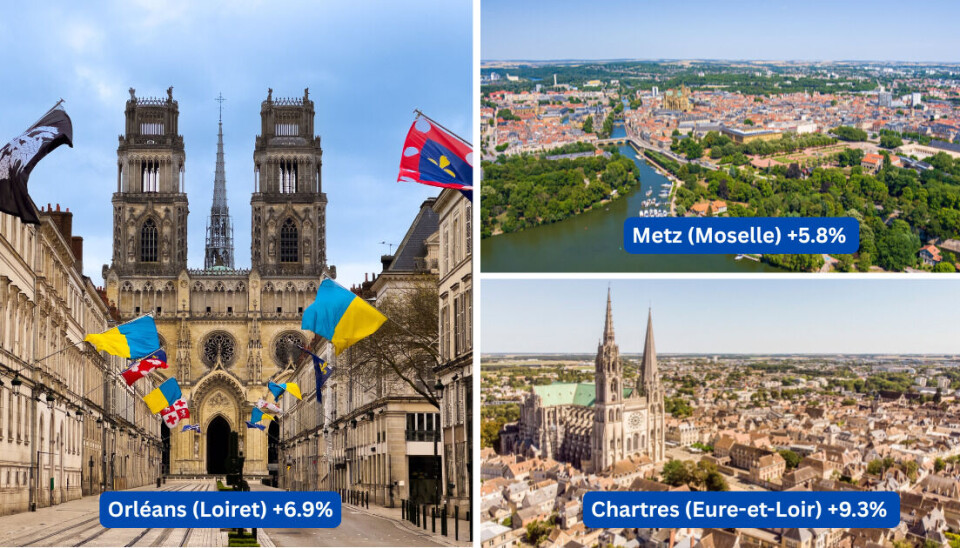


House prices in France are rising in some cities and falling in others, but overall they are edging down, according to the latest data from the Notaires de France.
Prices for existing houses fell by 1.3% nationally in the year to the end of June 2026, with sharp drops in cities such as Brest, Châteauroux and Dijon offset by strong gains in Chartres, Orléans and Montauban.
Sales are holding up for now: 951,000 existing homes were sold in the 12 months to the end of August, up 3.6% on a year earlier. However, notaires warn that growth has slowed sharply from almost 13% at the end of 2025, and sales could fall back to around 920,000 by the end of the year.
With mortgage rates approaching 4% and uncertainty over public finances ahead of the 2027 presidential election, they say buyers are taking longer to decide and negotiating harder, while some sellers are holding off rather than accept lower prices.
While the relatively strong performance in home sales may temper fears that a renewed property slump is on the way, notaires raise concern about the slowdown in sales and various price drops, with the market facing a renewed period of uncertainty.
However, analysis of the sale price of non-new build houses showed a spread of rises and falls across France.
Cities in the Loire Valley and east mostly saw price increases, with price drops seen across France. The most expensive and cheapest areas remain consistent with historical datasets, with high prices in the Mediterranean reflecting its status as a desirable place to live.
Increases of +12% and +10% in south
The most recent data shows sustained growth across the north, continuing the patterns recorded in the most recent data set (covering up to March 2026).
Most of the strongest-performing cities are again located in the north or east.
However, the two best-performing cities/areas were located in northern Corsica (+12%) and Montauban (Tarn-et-Garonne, +10%).
The other locations with strong price increases were:
Chartres (Eure-et-Loir): +9.3%
Orléans (Loiret): +6.9%
Metz (Moselle): +5.8%
Tours (Indre-et-Loire): +5.7%
Troyes (Aube): +5.3%
In turn, price drops were noted mostly in the centre and the south, with three cities seeing drops of at least -5%. The worst-performing cities were:
Brest (Finistère): -6.2%
Châteauroux (Indre): -5.8%
Dijon (Côte-d'Or): -5.5%
Southern Corsica: -4.7%
Bordeaux (Gironde): -3.1%
Nîmes (Gard): -2.3%
It is worth noting that in the previous dataset, Brest was among the best-performing cities for price increases.
Alongside Bordeaux, other major cities including Toulouse (-2%) and Nantes (-0.3%) saw price drops.
Paris is included with the wider Île-de-France region due to a lack of houses (but is covered separately for flat data), with the region seeing a -1.5% drop.
Elsewhere, Lyon (+4.6%) and Marseille/Aix (+2.4%) recorded increases.
Southern coast remains most expensive, west and centre less expensive
The dataset also covers median house prices in major cities throughout France.
Trends remain similar, with cities closer to the Mediterranean remaining the most expensive.
Some cities made up primarily of flats (for example Paris, Nice, Rennes, and Strasbourg) and with relatively few houses are excluded from the dataset due to a lack of eligible properties.
The most expensive areas for buying a house were:
Southern Corsica: €471,600
Toulon (Var): €450,000
Montpellier (Hérault): €403,600
Lyon (Rhône): €390,000
Marseille/Aix (Bouches-du-Rhône): €390,000
Bordeaux (Gironde): €326,200
Other areas to record average prices of €300,000 or above were Nantes (Loire-Atlantique, €305,000), Île-de-France at €320,000, and Toulouse (Haute-Garonne, €300,000).
Conversely, the cheapest cities were distributed more evenly across France, with entries in the north and east as well as the south and west.
The least expensive cities, all sitting at €200,000 or below, were:
Châteauroux (Indre): €122,500
Limoges (Haute-Vienne): €167,800
Poitiers (Vienne): €178,300
Troyes (Aube): €179,000
Amiens (Somme): €180,000
Rouen (Seine-Maritime): €185,000
Despite continuous price increases in recent datasets, most cities in Brittany, Normandy, and the north and east of France see median prices between €200,000 and €300,000, falling into neither the cheapest nor most expensive categories.
The information comes from the latest dataset from the Notaires de France.
It is the most comprehensive information on France’s property market, covering the sale of all new and existing homes (typically those five years or older or with at least one previous owner) across a given time period.
It is the most accurate data on house prices in France but due to the time it takes to compile the information comes out around four months after the period it covers.
The data below covers year-on-year changes between April 1, 2025 to June 30, 2025 and April 1, 2026 to June 30, 2026.
Notaires use preliminary data (such as for house sales and mortgage agreements) to make other predictions about the current and future state of the market, which we will cover in a future article.
You can see full details regarding house prices in the screenshot below.


