






explore france
Crane migration that marks the changing seasons in France
Thousands pass over France each spring and autumn
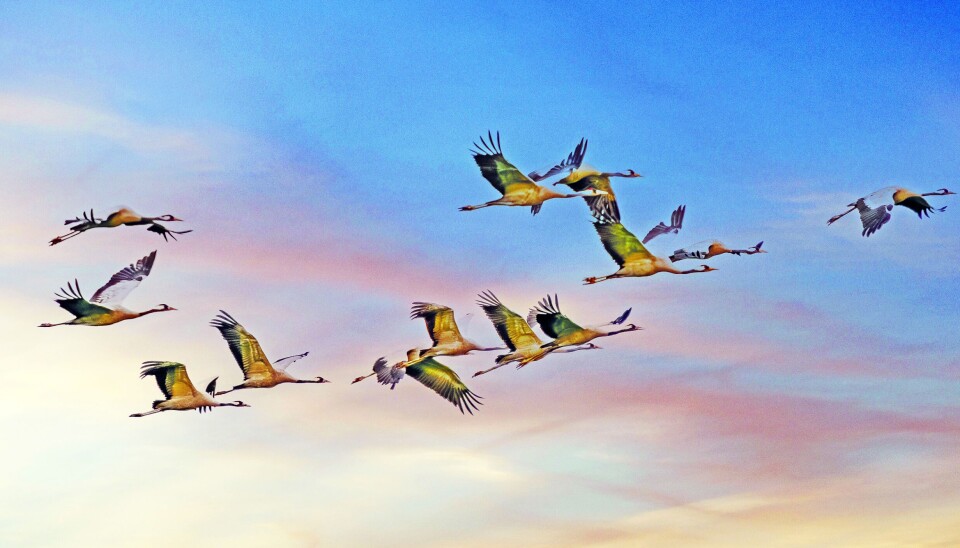


Imagine the scene. A cold, crisp day in late February after weeks of the damp, grey weather we would learn to associate with winter in Gironde.
We were working in what would become the garden of our new house and, to be honest, feeling pretty despondent.
Suddenly, from the south-west we heard a sound which could only be described as an airborne pack of hounds: a high-pitched, joyful baying. We both stopped what we were doing and stared in the direction of the din.
Our new neighbours had alerted us to this phenomenon, but we had not expected it to be quite so spectacular. The cranes (grues) were beginning their annual migration north.
Within a few minutes, the first of what would be many ribbons of cranes were flying towards us, weaving a tangle of V-shaped formations through blue skies as they made their way north-east towards Scandinavia. There they would assemble in their summer breeding grounds.
These remarkable birds make the journey each year in early spring, hatch and raise their young and then return at the end of the autumn, to overwinter in southern Spain and Portugal. In 2025 the French government recorded that the autumn migration took place between October 20 and November 15.
Where to see migrating cranes in France
The spectacle can be seen across a large swathe of France. Common cranes cross the country in a broad corridor, entering France from the north-east where one of their principal staging posts is the Lac du Der in Champagne.
From there they make their way across central France, passing over Dordogne and Gironde down to Landes. Here there is another important man-made halt, the Arjuzanx reserve, which is midway between Contis-Plage and the town of Mont-de-Marsan.
The Arjuzanx reserve was created on the site of old mining works and became a halt for the cranes before they make the last slog across the Pyrenees into Iberia. It provides what they are looking for – a marshy habitat, with light woodland and plenty of food from the maize which is grown in the area.
Since the late 20th Century, Arjuzanx has become an increasingly important rest site for them and, in recent years as temperatures shift, they have taken to overwintering there.
La Ligue pour la Protection des Oiseaux calculated that in 2018 around 40,000 cranes remained in the area rather than travelling further south. You can see them there, at the Observatoire de Villenave, from November to February.
How cranes manage their long migration
Our own observation of the birds as they pass overhead has been revealing. The crane at the front takes the strain, pushing through the air they fly into. The birds behind spread out in an aerodynamic V-shape, with smaller groups joining the main ones whenever they can catch up. From time to time someone else takes over the lead, so the heavy lifting is shared between the flock.
From time to time they stop flying towards their destination and start to circle. They are not looking for somewhere to rest, but rather catching rising currents of warm air and using the updraft to gain altitude.
Once the flock has gained enough height they set off again and are able to glide for long periods rather than constantly flapping their wings.
Our hearts sink when we see the cranes make their pilgrimage south each winter, because we know that the cold weather is following behind. But the joy we feel each February as we spot them flying north is beyond compare. It is the sound of springtime and the warmer weather to come.


