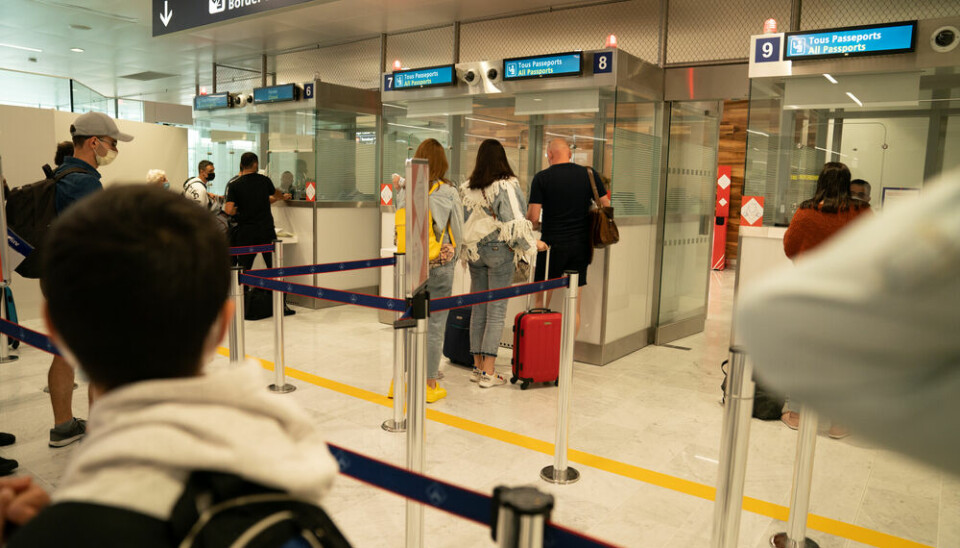
Passport not stamped upon leaving France and no biometrics taken: should I be worried?
Entry/Exit System digital border scheme requiring this was fully rolled out on April 10
Passports are no longer routintely stamped when passing through French borders
Frame Stock Footage / Shutterstock
Reader Question: I recently travelled to Saint Malo on the ferry. When I left I did not have to give my biometrics but also did not have my passports stamped. I am now worried that when I come back authorities will think I have overstayed and I will face a penalty. What should I do?
Although your passport was not stamped, your exit may still have been correctly recorded by border authorities.
When the Entry/Exit System (EES) became fully operational on April 10, it applied both for visitors entering and exiting the Schengen area.
Your passport details - and usually biometric data (facial image and fingerprints) - should be taken to create a database entry on the first entry/exit following the implementation of EES, then on subsequent trips you should be logged in and out.
At many French border points however EES was not fully implemented including biometric data by this date.
This was because of technical problems with pre-registration equipment (booths or tablet computers) to be used by passengers to speed up the process.
Check your EES data
This does not mean, however, that your exit was not recorded at all.
As part of the EES regulations, authorities at border points can partially suspend biometric collection/checks until September, and as mentioned such facilities are still not fully in place at all border points.
Since April 10, however, all countries have had to digitally track the entrance and exit of all passengers at every border point, regardless of whether biometrics were collected or not.
It means that from this date, all manual stamping of passports by border officials was theoretically meant to end (in the phased roll out of EES between October 2025 and April 2026, some manual passport stamping still occurred)..
You should, therefore, have had your exit recorded and have an entry in the digital EES database.
Is it possible to check?
‘Overstaying’ in the Schengen area can have consequences, notably if you try to enter France but are recorded as having used up all your days, you could be refused entry. So, it is worth trying to check.
Firstly, the EU has a new tool hosted on the EES website intended for people to check the number of days they have remaining to stay in the EU at any given time (note that you may also still use the EU’s Schengen short-stay calculator to do your own calculation of remaining days).
If you check this and all appears to be in order, then this may provide reassurance. However, the website states it may not be fully accurate at present, as the system beds in.
Alternatively, the EU says you have the right to ask border guards to tell you how many days you have left.
We would suggest keeping proof of the date of your last travel out of the bloc, so you can show this and explain the situation if the figure given appears incorrect, or if you are wrongly told that you have no days left. Guards can correct the records if necessary.
Finally, under EES rules, any traveller has the right to ask EU authorities about the data held on them. If it is incorrect, they can ask authorities to update this information.
For data collected from entries and exits at French border crossings, you could write a letter to one of two authorities for more information.
These are:
Le Délégué ministériel à la protection des données, Ministère de l’Intérieur, Place Beauvau, 75008 PARIS
In your letter, you should explain the issue and seek confirmation that your exit was correctly recorded.
If, however, it was recorded incorrectly (and there is no database entry for you), you can ask them to manually alter this, providing proof of your journey back to the UK.
However, it is likely that your exit was in fact recorded, so whether this extra paperwork is justified is something only you can decide.
If you are unsatisfied with the outcome, you can file a complaint about the process.
Official information on how to do so is available in English here.