






-
Bee yoga: Inside an unusual wellness experience in south-west France
'It’s about creating a connection with bees and learning to communicate with them'
-
Five ‘notorious green alien’ invasive plants you can find within France
Learn about five invasive plants, including Japanese knotweed, ragweed and pokeweed, and how they threaten native ecosystems
-
Efforts to combat tiger mosquito using sterilised insects expand in France
More French towns are set to adopt the innovative technique next spring
‘Sex traps’ can control Asian hornets, new French-Chinese study shows
The pheromone-laced traps can successfully capture males and reduce the number of future hornet queens. The hornets are a significant threat to bees and biodiversity
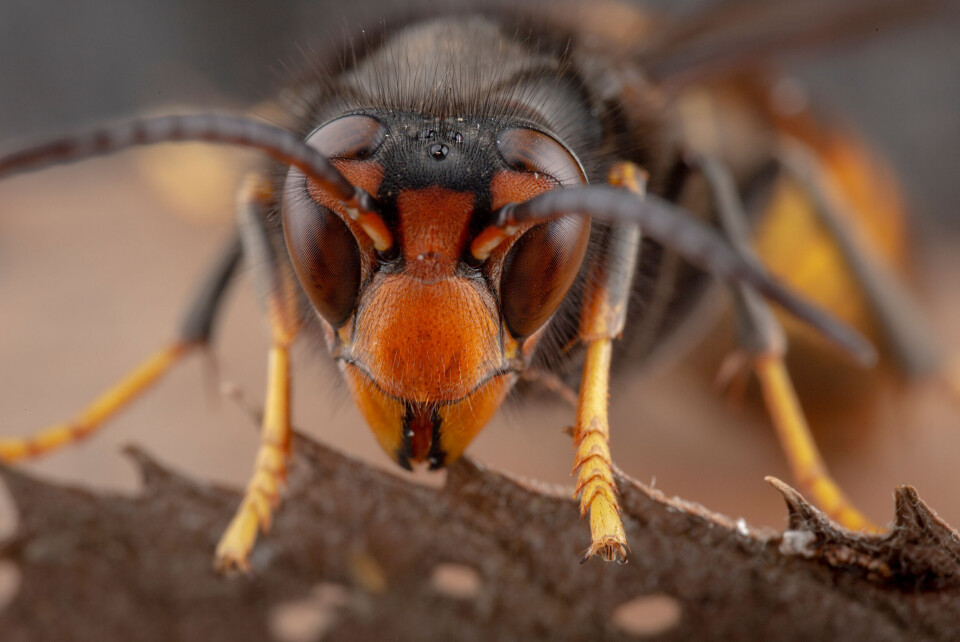
A new kind of effective trap for Asian hornets – which pose a threat to bees, biodiversity - and sometimes humans – could soon be created after a project by French and Chinese scientists yielded promising results.
The project identified and uses sexual pheromones of the hornets (frelons asiatiques in French) to make more effective traps.
By using a blend of the pheromones as ‘bait’, the scientists found that they “could attract numerous males during the breeding season and move future queens away from new colonies,” a statement from the University of Tours, which was involved in the project, explained.
A trap using such a method would then enable “the capture of these males in large numbers, before they are able to mate with future hornet queens.”
This would lead to a reduction in the number of Asian hornet colonies, or make colonies smaller.
The results of the study were published, in English, in the scientific journal Entomologia Generalis on February 7.
‘Speaking the hornets’ own language’
The new study comes after researchers in Manche, Normandy, also discovered a “very promising” solution to combat problems related to hornets in 2020, which they described as “talking to the insect in its own language” to lure it into traps.
At the time, Eric Darrouzet, teaching researcher at insect research institute l’Institut de Recherche sur la Biologie de l'Insecte (IRBI), told France 3: “Humans communicate orally. Insects communicate chemically, by emitting molecules. For example, a stressed worker hornet will emit alarm molecules, to call for help; or in contrast, to make its peers flee to avoid the danger.
“The only way to be effective against the Asian hornet is to speak to it. We have to speak in its own language, to tell it to go away, to attract it to a trap.”
The Asian hornet (Vespa velutina nigrithorax) "is known for the havoc it wreaks on bee colonies, biodiversity, and the accidents it causes every year. Many people are stung and some die", the University of Tours said.
Threat to biodiversity
First seen in France in around 2004, the Asian hornet has rapidly spread across the country and is now found nationwide, including in the northern regions.
It is known to cause widespread damage to bees and beehives, as it eats bees; and is often seen as a threat to biodiversity.
The hornets can also be deadly to people, though only in rare cases and as a result of multiple stings, usually while people are trying to destroy nests.
While the sting is about as dangerous as that of a normal European hornet or wasp, some people may be more sensitive than others – and even one sting can be fatal for someone with an allergy to the venom.
Related articles
Trapping Asian hornet queens now reduces summer nests: French study


