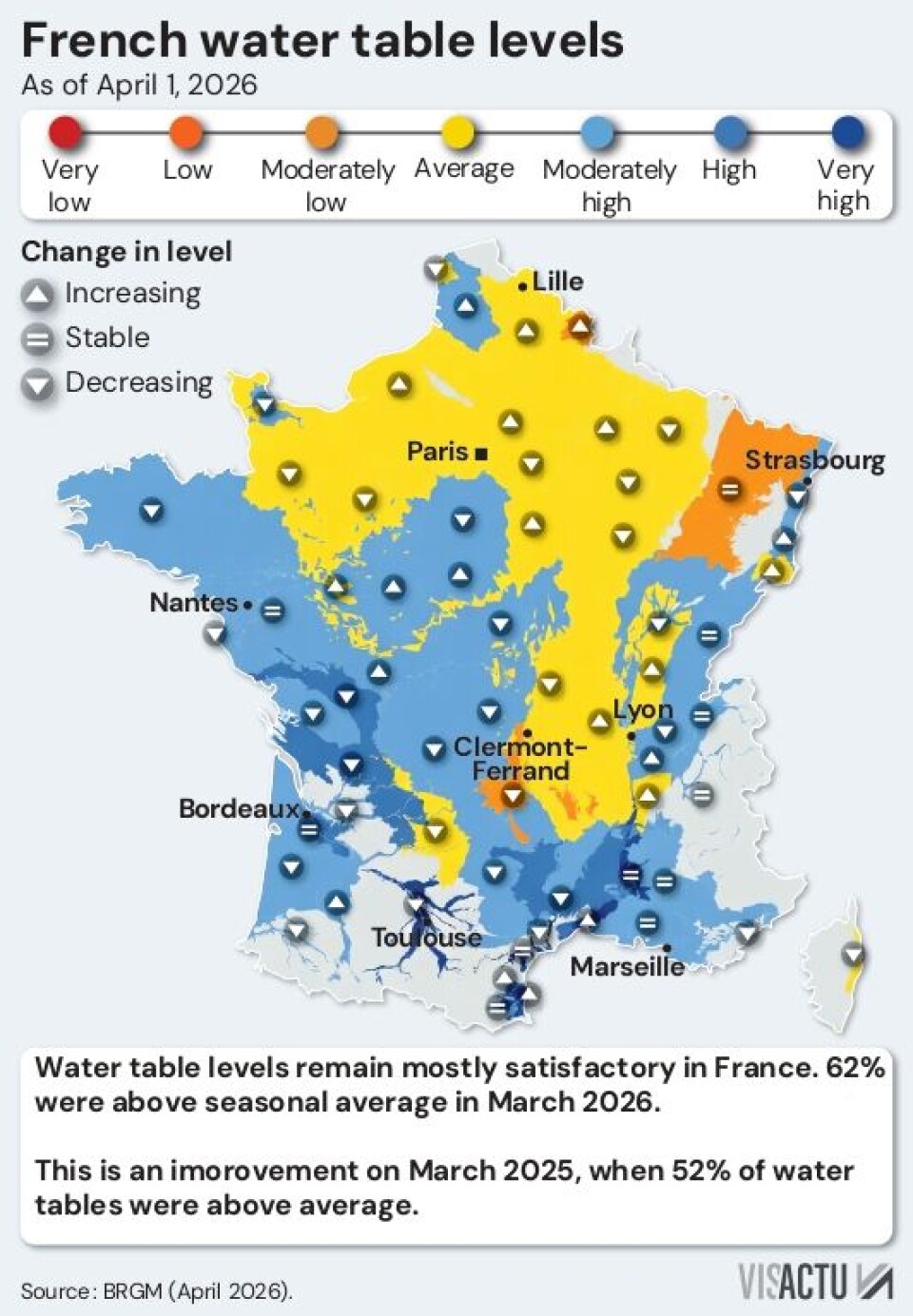
The majority of water tables remain at above average levels in France, although the dry March did see levels in some places being depleted.
Water tables are at higher than average levels in much of the west, centre, and Rhône Valley, as well as in the south along the Spanish Catalan border following several years of extreme shortages.
Areas served by the Parisian basin and the north remain at average levels, comparable to typical amounts seen in spring.
Only the east around Alsace and parts of central France are at lower than average levels.
In total, 62% of water tables measured by the BRGM (Bureau de recherches géologiques et minières) were above average compared to typical March levels.
Are droughts expected this summer?
Despite the positive news, there is still a risk of drought this summer.
The lack of rainfall in March meant that reservoirs depleted more than usual for this time despite being largely replenished at the start of the year.
Record rainfall at the start of the year helped replenish aquifers across France, however after a certain point during heavy or persistent rainfall soils become waterlogged and after this rain cannot make its way to reservoirs deeper underground.
This limited the effectiveness of winter rain on filling water tables above a certain amount.
“The preliminary assessment of winter recharge for 2025-2026 suggests that satisfactory levels are expected in most aquifers for the next quarter,” said the BGRM.
“However, uncertainties remain regarding the effectiveness of the April rainfall, with vegetation regrowth and a gradual increase in water demand to meet various uses, particularly agricultural ones. Longer-term forecasts remain uncertain.”
You can see a comparison between the levels in 2025 and 2026 at the bottom of the BRGM report via its interactive map, available here.