






news
More French communes adopt DNA testing in fight against dog mess
Municipalities are using genetic testing to trace dogs whose owners fail to clean up after them

Published
Modified


Dog mess left on pavements is one of the most common nuisances of urban life, an inconvenience that has led a number of French municipalities to adopt DNA testing.
Béziers (Hérault), Saint-Omer (Pas-de-Calais) and L’Escarène (Alpes-Maritimes) are among the municipalities that have introduced systems allowing the mess to be matched to the animal and, subsequently, to its owner.
While all three municipalities report significant improvements in cleanliness, the approach has not been without controversy.
Béziers’s legal battle
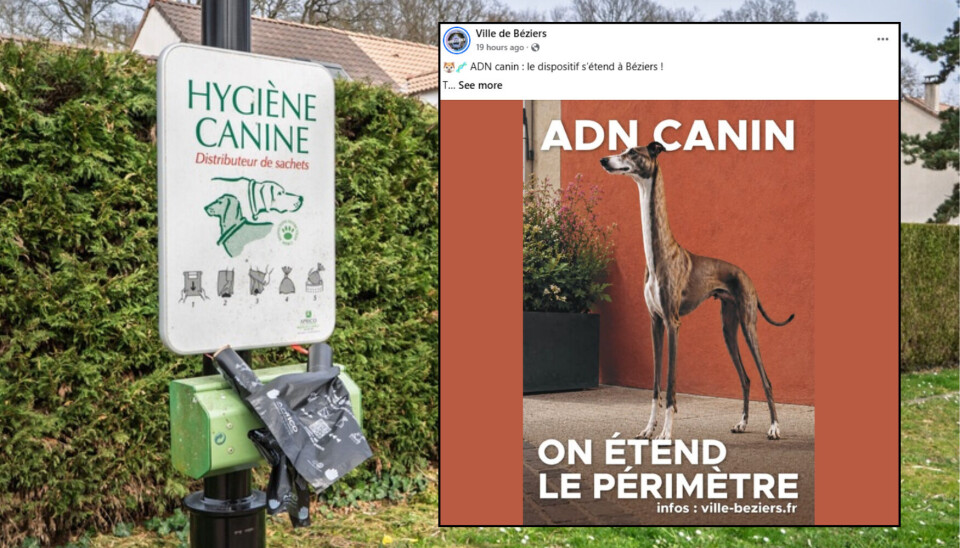
Béziers has been using the system since 2023. The city said dog mess in the city centre has fallen by 85%, with 2,247 dogs now genetically identified. It has consequently decided to expand the area covered by the scheme, with checks in the new zone due to begin on November 15.
In May 2025 though, the Administrative Court in Montpellier annulled Béziers’s original order, ruling that mandatory genetic identification was not “necessary, appropriate or proportionate”.
Its mayor Robert Ménard nevertheless issued a new order reinstating the measure.
The results elsewhere
In Saint-Omer, the scheme began in June 2025. The commune said dog fouling fell by 60% during its first year, leading it to extend the scheme from the main shopping streets to the wider urban area.
In L’Escarène, a commune of around 2,500 people in the Alpes-Maritimes, the system was introduced in 2024. Around 70 dogs had been registered by the end of 2025.
The commune said places that had previously been regularly fouled, including near a school, had become clean without needing to issue a single fine, according to Franceinfo.
How the DNA collection works
Owners have their dog's DNA collected by a veterinarian, usually through a quick swab inside the cheek. Saint-Omer described the procedure as “quick, simple and painless”.
The sample creates a genetic profile linked to the owner. When an uncollected dropping is found in a controlled area, municipal officers can take a sample and send it to a laboratory. If it matches a registered dog, the owner can be identified.
The penalties vary between towns as well. In Béziers, failing to produce the genetic identification card (which is obligatory to be carried by a dog’s owner at all times) can lead to a €35 fine, while an identified uncollected deposit carries €130 in cleaning costs.
In Saint-Omer, failing to present the card can result in a fine of up to €150, while failing to clean up dog mess can incur up to €173 in charges. In L’Escarène, the municipality has set a €300 fine for an identified offence.
Saint-Omer also gives owners 72 hours to produce their genetic identification card if they do not have it during a check.
The system depends, however, on owners having their dogs registered in the first place.
When a DNA sample cannot be matched, municipalities can still find other ways to find the owner. “We went to a street in the town centre where residents had been complaining. When the analysis of the droppings came back inconclusive, we sent our municipal police officer to patrol at the usual times for this type of nuisance late at night or early in the morning. She was able to identify the offender,” Jean-Claude Vallauri, the deputy mayor for urban planning in L’Escarène told France 3 Côte d’Azur.
There are costs to the system too. In Saint-Omer, analysing dog mess costs €34.10 before tax, with the cost passed on to the owner if their dog is identified.
L’Escarène, however, said the scheme has reduced its cleaning bill as the commune spent less than €5,000 on the system in its first year, compared with around €23,000 previously spent each year cleaning up dog mess.


