Farmer protests to continue despite France opposing Mercosur trade deal
French opposition to free-trade deal did not swing scale on key vote
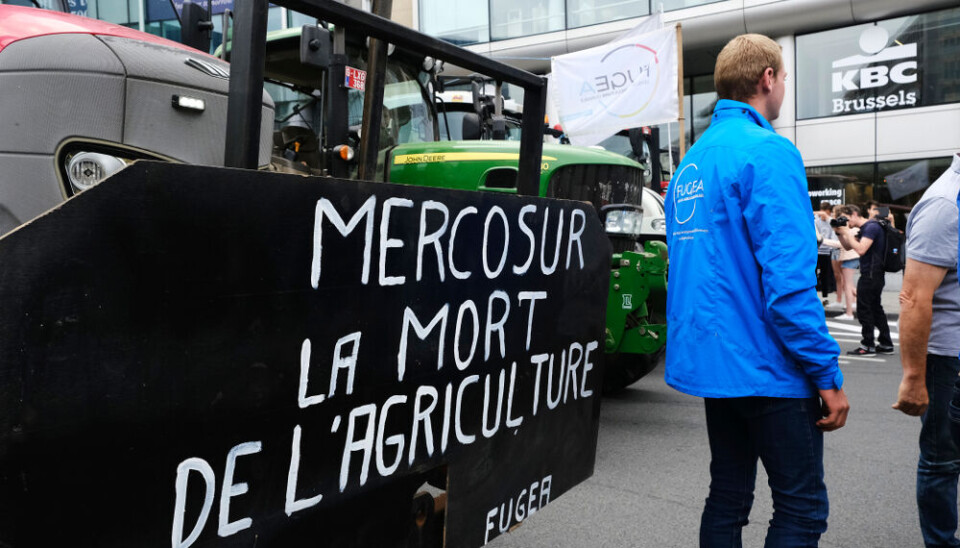
Protests against the controversial bill have taken place for several years, but could heighten in the coming days. Archive photo from a 2019 protest in Brussels, Belgium
Alexandros Michailidis/Shutterstock
France's vote against the controversial EU-Mercosur free trade deal was not enough to prevent it from passing, after it gained enough support from EU member states.
French President Emmanuel Macron announced yesterday evening that France would vote against the deal in a post on social media site X, after he had informed the president of the European Commission Ursula von der Leyen earlier in the day.
“France supports international trade, but [Mercosur] is an outdated agreement, negotiated for far too long on outdated terms (the 1999 mandate),” the president said.
“While trade diversification is necessary, the economic benefits of the agreement will be limited for French and European growth (+0.05% of EU GDP by 2040 according to the Commission). It does not justify exposing sensitive agricultural sectors that are essential to our food sovereignty,” he added.
France is ultimately open to such a trade deal, he said, but not in its current format. Several points of contention including safeguarding, food controls, and mirror measures were not in place in time for Friday’s vote.
While the stance may garner recognition at home, particularly among protesting farmers, it risks diplomatic tension between the president and several European allies including Germany.
Despite last night’s announcement, several fresh demonstrations and blockades by farmers began this morning, with many citing the imminent Mercosur vote as the key factor behind action.
This includes a new blockade of the A63 in the Pays Basque, demonstrations and ‘go-slow’ operations on the Paris ring road, blockades of the A2 and A27, and several demonstrations in cities and towns across the country.
Some blockades in the south-west relating to ongoing protests against the government’s treatment of cattleherds with lumpy skin disease remain, including on the A64 near Toulouse and the N21 near Foix.
Use our article to check for live traffic updates in your area.
Mercosur vote passes
‘Mercosur’ (from the Spanish Mercado Común del Sur) is the press moniker for the controversial trade deal, which would implement a free-trade deal between the entire EU bloc and four South American countries in the Mercosur arrangement – Brazil, Argentina, Paraguay, and Uruguay.
You can read about what the bill entails in our article here.
EU rules on major bills of this type require a qualified majority to pass. In this case, support is needed from 15 out of 27 member states, with ‘yes’ votes comprising at least 65% of the EU’s overall total population.
Alongside France, Ireland announced its intention to vote against the deal yesterday. Poland and Hungary have also continually stated their opposition to the deal and are expected to vote against it.
These countries together, however, were not enough to prevent the deal from passing.
Italy, which for a long time positioned itself as a chief critic of the bill alongside France, recently announced it would vote in favour on Friday’s vote.
Alongside Germany and Spain, it means three of the four largest economies and countries by population in the bloc back the agreement.
The deal is set to be officially inaugurated in the coming days, with Mrs von der Leyen expected to fly to Paraguay and sign the deal on Monday (January 12).
Immediately after the vote passed in Brussels, far-left La France Insoumise filed a motion of no confidence against French Prime Minister Sébastien Lecornu after the 'humiliation' the country faced.
Far-right Rassemblement National are also said to be eyeing up a similar motion.
How will French farmers react?
Recent farmer protests in France have centred on both the government’s reaction to the outbreak of lumpy skin disease – particularly mass culling orders – as well as the EU-Mercosur deal.
This culminated in a major protest in Paris on Thursday (January 8) organised by the Coordination rurale union after farmers descended on the city from across France.
In the south-west, demonstrations including roadblocks have continued for several weeks, although protests in this area are mostly focused on the lumpy skin disease as the epicentre of recent outbreaks.
It is unknown how farmers will immediately react to Friday’s vote, but further protests and demonstrations could continue into the weekend.
At a national level, unions are divided on action.
The FNSEA – the country’s largest agricultural union – alongside its youth branch Jeunes Agriculteurs, have announced major action outside the EU Parliament in Strasbourg on January 20 if the deal is approved.
“The current issue is Mercosur, and Mercosur is being negotiated in Brussels. Tractors in front of monuments in Paris aren’t going to make a difference,” said FNSEA president Arnaud Rousseau to media outlet Le Figaro.
It is worth noting that the FNSEA called on members to stop protests surrounding lumpy skin diseases, following agreements made with the government on the matter before Christmas, and have not officially participated in action since then.
However, the next largest unions, Coordination rurale (responsible for yesterday’s protests in Paris) and the Confédération paysanne, have today called on members to engage in blockades and protests in a show of strength against Mercosur.
These latter unions are the main groups who may continue to protest in the coming days after the deal is signed.