Interiors: Jacques Grange's thoroughly modern classicism
Pierre Passebon reveals a selection of master designer Jacques Grange's latest projects across Europe and the United States, showcasing his wide-ranging inspirations and his natural elegance
Vibrant colour accents energise this Saint-Tropez salon, where an Éric Schmitt Champignon side table anchors the composition alongside an African sculptureNicolas Matheus
When Jacques Grange’s personal collection was auctioned by Sotheby’s in 2017, it was not just a group of objects that went on view; it was an intimate world suddenly opened to the public eye.
Bidders from 38 different countries (totaling 2,500 bids) vied for each piece, revealing the deep fascination and desire Grange's universe inspires.
Through this exceptional sale, what emerged was not only a curated ensemble of masterpieces, but a glimpse into the private life of an aesthete and the coherence of his taste.
Beyond his lifelong passion for the decorative arts, Grange had, since his youth, formed a profound bond with painting, sculpture, and contemporary creation.
His preferences revealed an expansive curiosity: Joan Miró, Pablo Picasso, Henri Matisse, David Hockney, Max Ernst, René Magritte, Damien Hirst, Giuseppe Penone, and Daniel Buren… names that together sketched a secret map of his inspirations.
Le Bar aux autruches by François-Xavier Lalanne and a sculptural chair by Alexandre Noll both set global records for those artists.
More than just a market event, the sale revealed, lot by lot, Grange's personal sensibility, highlighting his singular eye and deep love of art. For some, it was a discovery, for others, a powerful confirmation.
Following the sale, collectors from around the world turned to Grange to create interiors in harmony with their own artistic sensibilities. With many, a genuine rapport took root – one that went far beyond decoration, built on a shared passion for art.
What they sought was the marriage of sophistication and apparent simplicity removed from excessive or clumsy refinement, and anything forced or ostentatious. The work of a decorator is demanding, crafted for clients who crave beauty and individuality.
In this book, public spaces, historic sites, and scenographies sit alongside private homes, all united by a common thread: a sense of comfort, non-conformity, harmony, elegance, and a French tradition stripped of nostalgia: the Jacques Grange touch – a classicism that feels thoroughly modern.
Colette’s childhood home in Burgundy
Colette’s childhood home, located in Saint-Sauveur-en-Puisaye, Burgundy, has been meticulously restored to resemble the intimate world she once knew.
The celebrated French writer spent her early years there, and this house – affectionately called ‘the house of Sido’, after her mother – became a recurring presence in her work.
Jacques Grange, an admirer
of Colette and current owner of her last Parisian apartment near the Palais-Royal, created the bedroom curtains in the exquisite Madeleine silk lampas by Verel de BelvalNicolas Matheus
Thanks to the careful efforts of the private association La Maison de Colette, along with Grange’s expert touch, the interiors and gardens have been brought back to life with extraordinary authenticity.
Fragments of original wallpaper were reproduced using traditional 19th-Century techniques, walls were refinished with lime, and woodwork was restored using historical methods.
Though only 20% of the original furniture was recovered, donations and Colette’s own vivid descriptions filled in the gaps. Grange, who lives in Colette’s last apartment in Paris, offered invaluable guidance in preserving the spirit of the home.
A remarkable example is the gray lattice-patterned wallpaper found beneath layers of paint in Colette’s bedroom. It was faithfully reprinted by the Atelier d’Offard, a specialist in block-printed wallpapers from the great 18th and 19th-Century French manufactures.
The restoration is grounded not in innovation or grandeur, but in memory – echoes of a honey-coloured doorframe, the pattern of a curtain, or a few old plants still growing in the garden.
Colette’s own words were the primary blueprint: her bedroom, “my den, my lair,” the tiny dining room for six, her mother’s sewing table, and even the separate beds with individual canopy tops – every detail was guided by her prose. The result is not just a house, but a living embodiment of her literary world.
The Pathé Palace cinema in Paris
Pathé Palace cinema, formerly known as Paramount Opéra, has recently reopened its doors in Paris after an ambitious and luxurious renovation.
Located at the corner of Boulevard des Capucines and Rue de la Chaussée-d’Antin, the cinema now offers an exceptional experience that blends heritage with innovation.
Italian architect Renzo Piano restored the building while preserving its vintage grandeur.
Pathé Palace is elegant and brightNicolas Matheus
A marble staircase, restored to resemble the original Paramount cinema from 1927, welcomes visitors into an elegant, light-filled hall crowned by a lush glass canopy.
The cinema features seven screening rooms. The largest, with more than 400 seats, is equipped with Dolby Vision and Dolby + Atmos; the six others, ranging from 29 - 96 heated semi-reclining leather seats, are fitted with Samsung Onyx LED screens and Dolby Atmos sound systems.
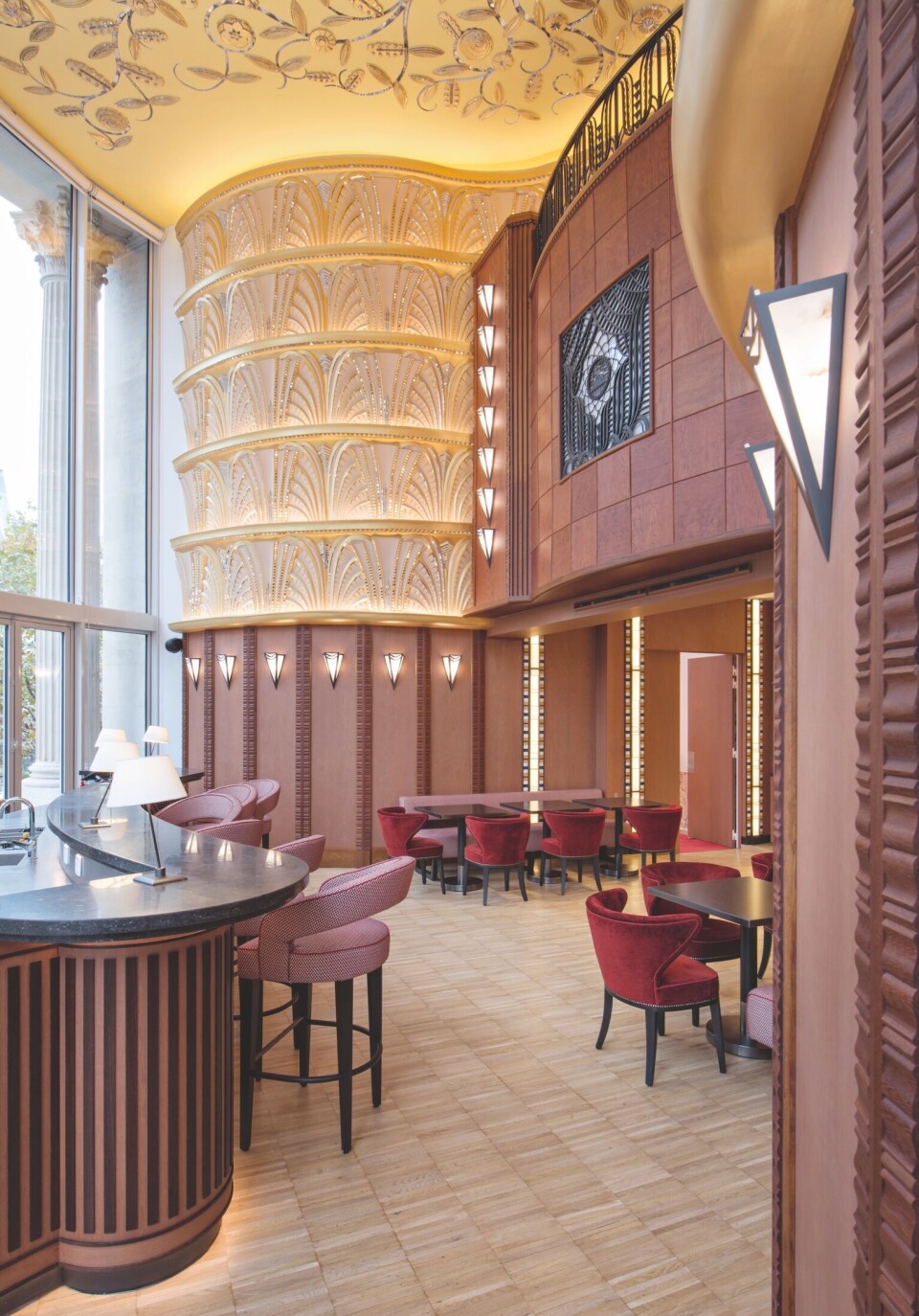
The bar, restored and completed by Grange, was inspired by the golden age of the 1930’s. Its soaring decorated ceilings, soft lighting, and opulent atmosphere offer visitors a voyage through time.
Grange’s involvement was essential – restoring such an important Parisian monument required someone with a perfect understanding of both Parisian history and contemporary elegance. The result is a space that evokes prestige and timeless charm.
Described by Pathé president Jérôme Seydoux as “a reasonable folly,” the Pathé Palace is more than a cinema: it is a dreamlike destination where imagination and emotion take centre stage, right in the heart of Paris.
A villa in Saint-Tropez
In the heart of Saint-Tropez, where the glamour of the French Riviera meets the quiet charm of Provence, a villa designed by the architect François Vieillecroze and decorated by Grange perfectly captures the spirit of this iconic destination (see cover image).
Set around a shaded patio planted with lush vegetation and a serene swimming pool, the villa is a celebration of Provençal architecture featuring natural materials such as stone, terra-cotta, and wood. Large bay windows flood the space with light, blurring the boundaries between indoor and outdoor living.
Inside, Grange’s subtle aesthetic is on full display. The interior is an ode to purity and simplicity, dominated by a palette of crisp white. The calming atmosphere is punctuated by bold accents – two striking red armchairs in the living room serve as the only splash of vivid colour, drawing the eye and adding vibrancy to the space.
The bedrooms, also white, are furnished with natural materials and open onto a rooftop terrace, inviting relaxation under an azure sky.
Jacques Grange: New ProjectsFlammarion
The Mediterranean influence is further revealed in the use of light, flowing fabrics, and the villa’s open, airy layout.
A rustic yet elegant outdoor kitchen made of woven wood panels seamlessly connects to the patio, encouraging a lifestyle centered around nature, comfort, and casual sophistication.
This villa is more than just a home – it is a harmonious blend of Provençal tradition and timeless luxury.
Jacques Grange: New Projects by Pierre Passebon (Flammarion, 2025). Photography by Nicolas Mathéus