Why Bic pens pose a problem to teachers in France as schools restart
The BIC 4 Colour pen is a French design classic that is much loved by school kids - and much maligned by teachers
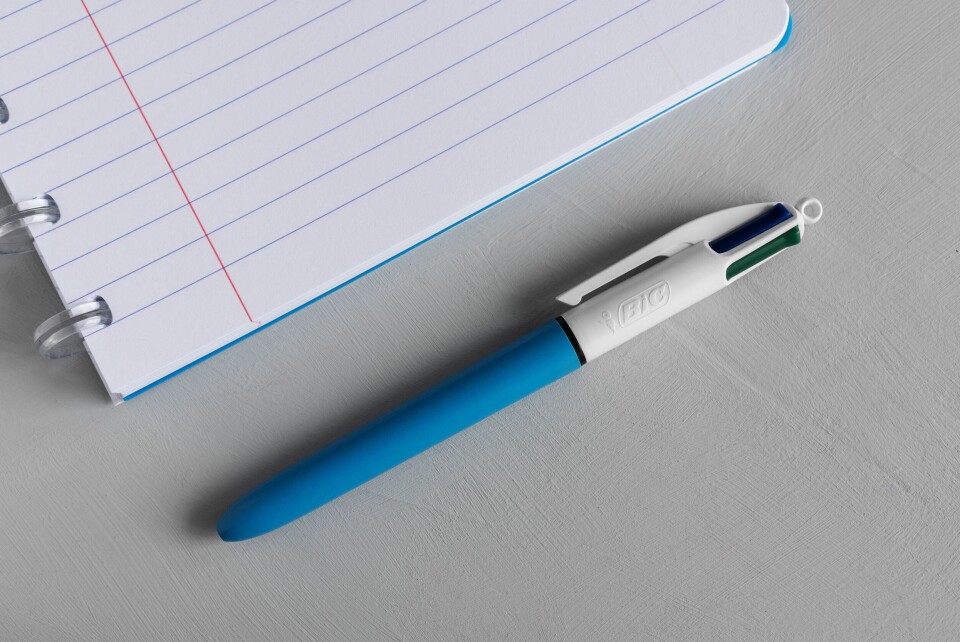
The BIC 4 Colours is a French design classic and the pet peeve of many teachers
Ana Belen Garcia Sanchez/shutterstock
Few French schoolchildren are likely to need an introduction to the BIC 4 Colours.
The distinctive pen, with four retractable ink colours in a single body, has been part of French school life since it was launched in 1970.
BIC describes it as a practical, robust design that remains popular with schoolchildren, students and others more than half a century later.
But what pupils regard as one of the great advantages of the pen – the ability to switch between colours with a satisfying click – can be rather less welcome at the front of a classroom.
Teachers have complained about the noise for years, with some banning the pens or threatening to confiscate them if pupils repeatedly click between colours.
And the clicking is only part of the problem.
‘Don't click or I’ll confiscate it’
The BIC 4 Colours allows users to switch instantly between blue, black, red and green ink without changing pens. BIC says the design has remained largely unchanged for more than 50 years.
That longevity is part of its appeal, but it also means generations of French teachers have had to contend with the same distinctive noise.
One teacher previously told French media that a single pupil clicking the pen could be tolerated, but that the sound became considerably more irritating when several children were doing it simultaneously.
Another said she warned pupils at the beginning of the school year that they could use the pens only if they did not constantly click them, otherwise she would confiscate them.
The problem is particularly acute because the mechanism makes it easy to play with the pen even when there is no need to change ink colour.
A schoolyard status symbol
The pen has also developed a following among children that goes well beyond its practical purpose.
Different versions and designs have turned the 4 Colours into something of a collectable, with pupils buying, swapping and sometimes arguing over them.
BIC itself has expanded the range considerably, offering different colours, finishes and decorations. The company says there have been more than 100 new 4 Colours designs over the years.
The range has also extended far beyond the basic school pen. BIC has collaborated with artists and luxury jewellers on elaborate versions, including a collection produced with French artist Richard Orlinski and jewellery house Tournaire.
This helps explain why the 4 Colours has survived as more than just a cheap writing instrument. It has become a recognisable object in its own right.
Why is it still so popular?
The pen's appeal is partly explained by its simplicity.
Four pens are combined into one, saving space in a pencil case and allowing users to change ink colour without reaching for another pen. BIC says one 4 Colours can write for up to 8km.
Its unusual design has barely changed since 1970, making it instantly recognisable to successive generations of pupils.
That longevity is notable at a time when BIC itself is under pressure to reinvent its business.
In September 2026, Le Monde reported that BIC's sales figures have fallen by nearly 7% between 2015 and 2025, while its global workforce and number of factories had also declined.
The company is now pursuing a strategy aimed at reviving growth by 2030.
Yet the humble 4 Colours remains one of the brand's most enduring products.
For pupils, that is because four colours in one pen is useful - and clicking between them is fun.
For their teachers, that second feature may be rather less convincing.