






-
French fuel price cuts of up to 18 cents per litre from November 1
Government releases strategic diesel reserves under new decree
-
A14 motorway set to become free as A13, linking Paris and Caen, will close temporarily
The measure replaces a previous 50% planned price discount
-
French roads suffer from cracks following summer droughts
Repairs underway as clay soil shrinkage and expansion impact roads
‘Glow-worm’ paint lines trialled as way to see in dark on French roads
The luminous paint absorbs energy from daylight to glow for 10 hours. Tests are taking place on roads in the south
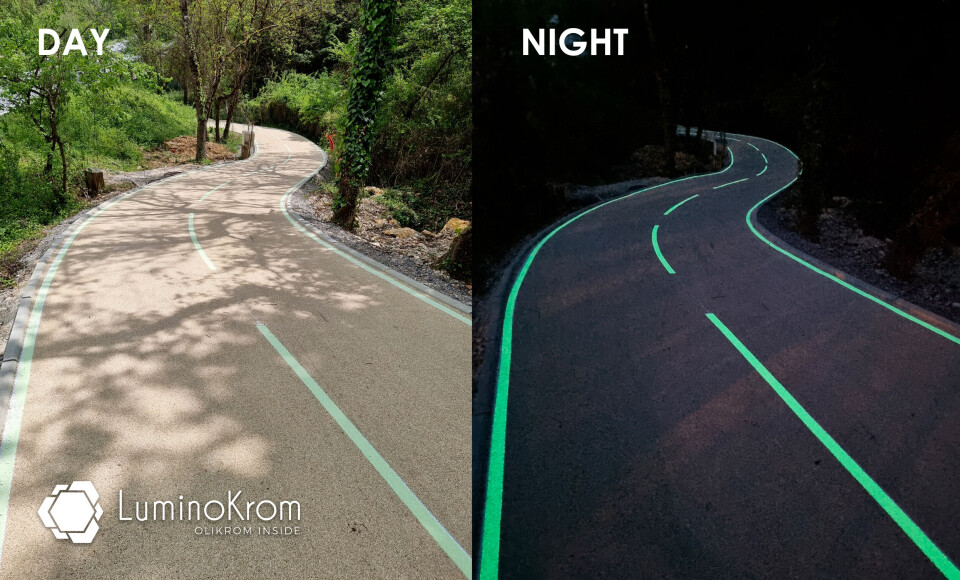
Trials of a luminous road paint that uses glow-worm technology are being held in southern France.
The paint absorbs energy from daylight or artificial lighting and then glows green in car headlights for up to 10 hours.
Leslie Gabrion of OliKrom, the Bordeaux company which invented the product, said: “We get up to 12 lumens of light, which is enough for the road to be well lit.
The idea is that it either replaces street lights, or is used in conjunction with them – for example, street lights can be left on until 10pm and then there will be light until 8am the next morning.”
The paint costs between €4,000 and €6,000 per kilometre and is guaranteed to last for four years.
It is double the price of ordinary road paint, but street lights are 50 times more expensive.
Trial stretches of around 150 metres each will be evaluated over at least two years in Landes and Alpes-Maritimes before the departments decide whether to use the paint more widely.
Unlike the phosphorous paint used in the past on watch and clock dials, it is not radioactive.
“Our team studied the chemistry used by animals such as glow-worms in order to make it,” said Ms Gabrion. “It is an entirely ecological solution.”
So far, the paint has been used mainly for cycle tracks and footpaths but its inventors also see it being used in ports, both as an extra safety device on ships and boats and to mark out quaysides and other potentially dangerous spots.
Cat’s eyes, the reflecting road studs common in Britain, have never caught on in France. Road engineers say the versions they were offered were too expensive, both to buy and to maintain.


