Car insurance premiums are expected to rise by a further 4–6% in 2026, continuing a long-term upward trend that saw average prices increase by around 8% in 2025.
The national average premium now stands at €751 per year, according to figures from comparison site Assurland.com – a rise of around 36% since 2010. Costs are higher in some regions, including Corsica and Provence-Alpes-Côte d’Azur, where premiums approach €950.
Industry analysts say the increases are being driven by more complex vehicles and the growing impact of extreme weather.
The grants were first introduced in September 2025 but initially applied only in around 3,000 communes scheduled for early disconnection of copper lines. Since March 1, the scheme has been extended nationwide.
Owners of their main residence with annual income below €29,316 may qualify. Applications are made via the Agence de services et de paiement, which pays approved installation work directly to contractors.
Ticket-free motorways
From late May 2026, sections of the APRR and AREA road networks, including the A41N (Lyon-Annecy), A43, A48 and A49 (Lyon-Valence via Grenoble), willswitch to ticket-free tolling.
The €50 million upgrade removes entry barriers, replacing them with overhead gantries that record number plates and télépéage badges to calculate tolls at exit points.
Barrier-free tolling aims to improve traffic flow and safety. Payment rules remain the same: users with a télépéage badge are billed automatically, while others must pay online or at authorised tobacconists within 72 hours. Unpaid journeys incur escalating fines, up to €375.
The finance ministry said a “malicious actor” accessed the FICOBA registry – which lists all bank accounts held in France – for several days at the end of January. Around 1.2 million active accounts were affected.
Data accessed included account identifiers such as IBAN numbers, as well as names, addresses and, in some cases, tax identification numbers and birth details.
The database does not contain account balances or transaction records but the stolen information could potentially be used to set up fraudulent direct debits.
Vegetation and litter also often accumulate around them, creating additional work for maintenance crews.
Concrete barriers are considered more durable and usually need fewer repairs, even after impacts. Authorities say this reduces the time road workers must spend near live traffic and limits the number of lane closures required for maintenance.
Only Nice and Montpellier recorded stable or improving finances, attributed to controlled budgets and targeted investment, particularly in ecological transition projects and transport.
Paris ranked last, with property taxes rising by more than 50% since 2014, despite its worsening financial position. The study also notes that Rennes fell from first place in 2015 to joint eighth in 2024 alongside Nantes, while Toulon remains the most financially stable despite a slight decline.
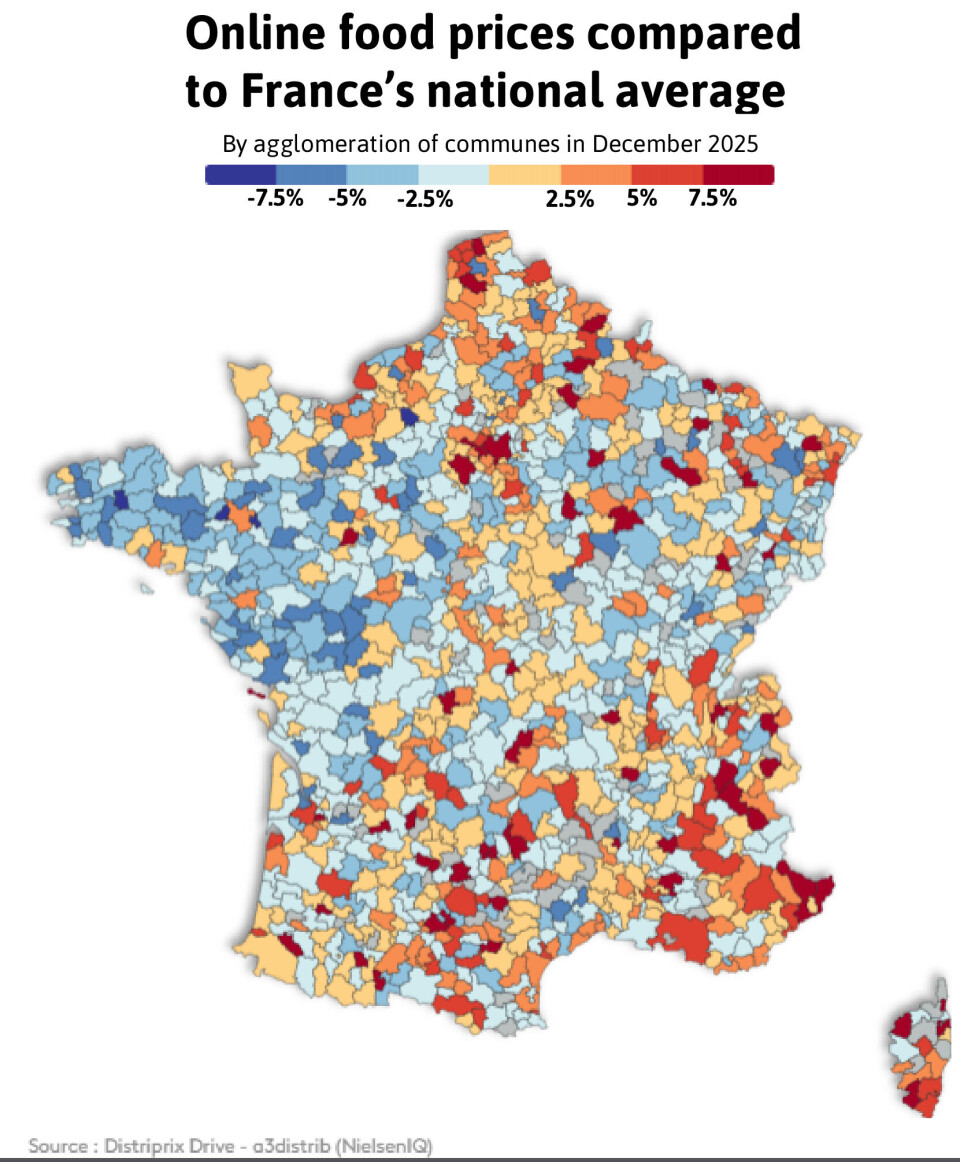
The colour-coded map is based on the Distriprix index, compiled by research consultancy NielsenIQ’s a3distrib division using data from 6,600 supermarket “drive” locations across the country.
NielsenIQ
Prices are typically higher in large cities and areas with less competition. By contrast, the lowest prices are mostly found in western France, particularly Brittany, where several areas are between 7% and 9% cheaper than average. Experts say lower land costs, proximity to agri-food industries, and the strong presence of lower-price chains such as E.Leclerc and Système U help keep prices down in these regions.
German border checks
Germany plans to extend temporary border checks with neighbouring EU countries, including France, for a further six months.
It will allow German border police to carry out identity checks on travellers entering via land borders, despite crossings within the Schengen area normally being open.
Germany says the checks have helped intercept tens of thousands of unauthorised entries.
First introduced in September 2024, the checks will now remain in force until at least September 15, 2026.
France has similar temporary controls in place on its borders with neighbouring EU countries and Switzerland until April 30, 2026, and may also seek to extend them.
Health insurance emails
Assurance Maladie has introduced a new design for its official emails aimed at improving readability and integration between smartphone apps.
The content of messages will remain the same. Main changes include: the logo will appear in the top left corner of the message; blue subheadings may be added to guide reading; at the bottom, a blue block simplifies access to information and logos provide a direct link to platforms for installing the Ameli app.
Buy or rent? Study can help
Mulhouse, Saint-Etienne and Limoges are among cities where buying property becomes financially advantageous over renting most quickly, according to a study by MeilleurTaux.
In Mulhouse it takes just 19 months for purchasing a 70m² property to become more profitable. The figure is 25 months in Saint-Etienne and 51 months in Limoges, largely due to relatively low purchase prices.
In Paris or Aix-en-Provence, buyers may need to own a property for more than 18 years before it becomes financially preferable to renting.
In the US and Canada, the service costs US$8.99 per month, providing access to news, documentaries, podcasts and the BBC News channel.
For French users, BBC Sounds access ended in July 2025, but the BBC World Service and Radio 4 remain available via BBC.com and the BBC app. Some podcasts are also accessible.
The three-day journey travels via the French and Italian Rivieras to southern Italy, combining on-board dining, excursions and two-night stays at a five-star hotel. Tickets start from £8,600.
Water bill hikes
Residents in several communes around Caen in Normandy say their water bills have jumped by up to 40%. The complaints concern bills issued by water company Saur for 2025 consumption.
The company says the increase is partly due to the rollout of remote-reading meters, meaning some invoices cover up to 15 months instead of the usual 12.
Local officials say residents were not warned. Water taxes introduced in 2025 have also pushed prices higher and they are expected to rise again in 2026.
The issue affects models of the 2 Series Coupé, 3, 4, 5, and 7 Series sedans, the 6 Series Gran Turismo, X4, X5, X6 and Z4 produced between July 2020 and July 2022. Affected vehicles face an issue with their starter motor, which may degrade and malfunction – potentially causing a short circuit.
BMW advises owners to enter their 17-digit Vehicle Identification Number on the official BMW website, to avoid leaving their engine running while unattended and to take the vehicle in for repairs as soon as possible.
There are slightly more than 1,000 wolves in France, according to the latest figures.
A decree published in February allows farmers to take a defensive shot during an attack, and authorises official wolf catchers to kill more to protect unguarded livestock.
Wolves have also been removed from the list of protected land mammals, and certain hunting procedures simplified. Farming unions criticised the measures as insufficient.