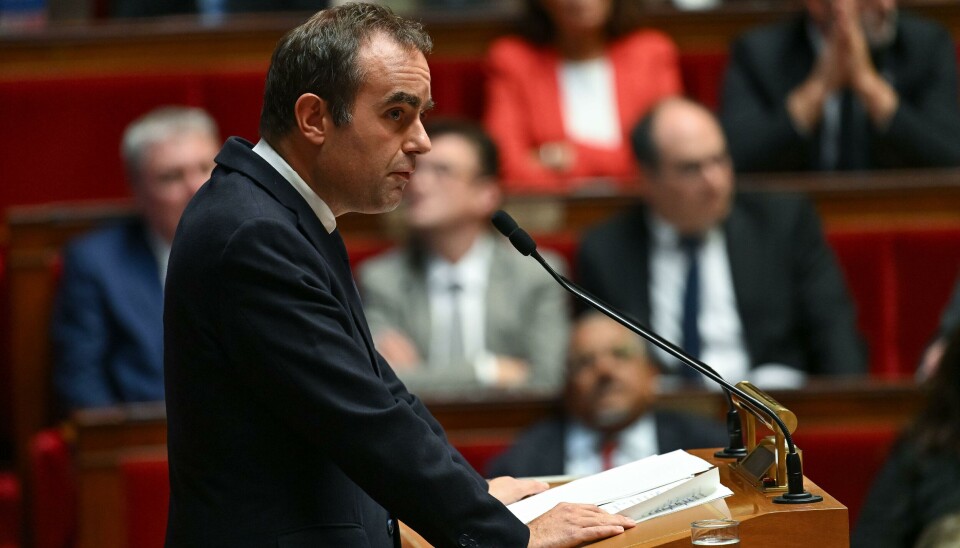
French Prime Minister Sébastien Lecornu is facing fresh struggles to pass the delayed 2026 budget, with the government claiming opposition parties are making it ‘impossible’ to pass the text via a vote.
Several upcoming debates on the budget have been cancelled, with no further sessions expected until Tuesday (January 20).
Mr Lecornu will seek the support of Socialist Party MPs and independents in the ‘LIOT’ group today (January 16) offering to amend the budget in return for guarantees the groups will not back potential future votes of no confidence against the government, and in the slim hope of gaining a majority backing for the bill.
A budget is now unlikely to be in place before mid-February – regardless of how it is implemented – despite the hopes of French President Emmanuel Macron who wanted text in place before the end of January.
At the end of each month, MPs must vote to renew the emergency laws that keep funding at the previous year’s levels. It is thought that each delay costs the economy billions of euros.
Alternative measures risk government collapse
The government is still hopeful that the text can pass via a vote at the Assemblée nationale, however if this is impossible it will need to opt for alternative measures.
These include attempting to force the budget through without a vote using Article 49.3 – forcing Mr Lecornu to renege on an earlier promise to avoid this measure – or via ‘ordonnance’ or executive order, an equally controversial power.
If Mr Lecornu resorted to Article 49.3, it would open him up to an automatic vote of no confidence on up to three separate occasions as the text is forced through.
If this happened and saw him toppled it would leave France back at square one, with neither a government nor a budget in place.
A second option would therefore be to pass the bill via decree through an ‘ordonnance’.
Certain bills such as the budget can be pushed through using an executive order, in extraordinary circumstances.
Article 47 of the Fifth Republic’s Constitution states “If parliament has not voted within seventy days, the provisions of [these bills] can be implemented by executive order,” turning the text into a decree passed without the backing of MPs.
It has not been used to pass a budget before, and could set an uncomfortable precedent for future debates, and is likely to be seen as an extreme authoritarian measure by the government.
The order would revert the bill back to the original draft introduced in October 2025, which included €30 billion in savings and was quickly rejected and heavily amended following debates in the Assemblée nationale and Senate.
MPs would almost certainly move to topple the government following this, with parties across the chamber vehemently opposing the idea in recent days.
Far-right MP Marine Le Pen has criticised the government for orchestrating a situation where the budget is passed via decree to implement the initial version of the text prior to parliamentary debates.
“The parties that make up the common base [i.e the traditional parties] have therefore lied, with the sole objective of preventing new legislative elections from being held,” she said.
Unlike Article 49.3 however, it would guarantee a budget of some form being passed even if the government subsequently fell following the decree.
For Mr Lecornu, who has consistently sought to place himself as a crisis-era prime minister who values achieving stability above any personal gain, the gambit and sacrifice may be worth the potential backlash.
Eternal Assemblée divisions remain
Neither Article 49.3 nor executive orders are attractive methods and the government is aiming to pass the budget via a vote from MPs, both to save face and keep itself in power.
Following the failure to pass a 2025 budget in December 2024, the reconvened parliament agreed fairly quickly on a slimmed-down version of the text, despite its failure to do so before the end of the previous year.
This perhaps stemmed from MPs being uncomfortable over the stigma of the unprecedented situation of France starting the new year without a budget and wanting to avoid further instability.
This year however MPs continue to fiercely debate and alter the slimmed-down text brought forward at the start of 2026.
Notably, the far-right Rassemblement National initiated an amendment that would result in €4.9 billion of local funding ultimately removed. The amendment passed and is currently in the version of the text being debated.
Several other elements of the bill remain contentious in the debates.
This includes increased taxes on large companies – put forward by the government in the hopes of gaining Socialist Party backing but resulting in some of its own MPs voting against it – as well as other spending issues and rules on landlord and tenancy rights and income tax brackets for the coming year.
Increased taxation for companies was ultimately rejected by the chamber, losing the government some good will among its own MPs without gaining Socialist Party support in return.
The version of the text as of Thursday January 15 would see the bill’s debt-to-GDP ratio see a 5.3% increase if passed, above the government’s red-line maximum of 5%.
Alongside disagreements with the left-wing Socialists, right-wing Les Républicains and members of the various centrist groups, the government has taken aim at the extreme flanks present in the chamber.
It says the bill has faced “continuous sabotage” from the far-left La France Insoumise and far-right Rassemblement National, making “the adoption of a budget by vote impossible.”
“We are definitively moving away from a compromise text acceptable to a majority of MPs,” said the Minister for relations with Parliament, Laurent Panifous, due to the inclusion of various amendments from the extreme parties.
The government is “solely responsible for having tried to impose a minority text, but it nonetheless places the responsibility on the Assemblée nationale,” replied Eric Coquerel, La France Insoumise MP and head of the parliament’s Finance Committee.
Is there any way out of the crisis?
Failing an agreement from MPs on the text, the eventual use of Article 49.3 or an executive order is all but certain to see the government toppled.
Mr Macron would then be forced to appoint yet another prime minister and cabinet despite limited options remaining.
With the presidential election a little over a year away, it is unlikely any non-government groups would form an alliance with Mr Macron’s MPs to provide backing.
Any party opting to ally themselves to an increasingly-unpopular government would do little to improve their electoral success next year, and they would have only limited opportunity to exert influence on government policy before the next elections.
This implies another year of a weak minority government and an Assemblée split between the left/far-left, centre/right, and far-right, and the potential that the 2027 budget will face the same hurdles as the last two.
One alternative is the dissolution of the Assemblée nationale and new legislative elections to return MPs.
With the presidential election fast-approaching, Mr Macron may be equally reluctant to dissolve the Assemblée for fresh elections to return a chamber for such a short time, and has stated continually that he will not resign early to bring forward a presidential vote.
While it is not mandatory for legislative elections to happen following the presidential election, it is almost certain they will be called for by the new president.
The Assemblée must have elections every five years (the next are currently scheduled for 2029) and the chamber must be in place for at least one year before it can be dissolved and new elections called.
As the eventual winner of the spring 2027 presidential election (which cannot be Mr Macron who is barred from running for a third consecutive term) will almost certainly aim to dissolve the chamber in the hopes of gaining a majority in parliament, parties will only realistically demand new legislative elections until spring 2026, and then look towards the 2027 election.