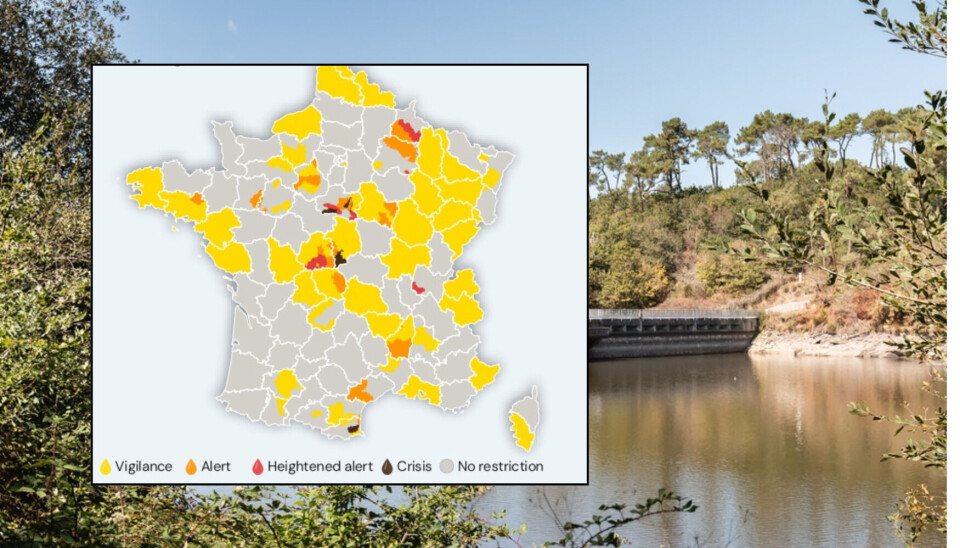
From Wednesday June 17, 51 departments across France are subject to prefectural decrees aiming to limit or reduce the use of drinking water, as the ongoing heatwave puts increasing pressure on water resources.
In total 335 zones are now affected, according to the government's platform VigiEau.
The measures taken range from simple calls for water conservation to stricter limitations on specific uses, due to different levels of pressure on water resources following a dry start to summer in many regions.
Authorities are urging both households and businesses to reduce their consumption in order to prevent the situation from becoming worse.
The restrictions are split into four levels of alert, each triggering different measures.
At the lowest level, known as vigilance, there are no mandatory restrictions. However, people are encouraged to reduce water use as a precaution.
The next level, alerte, introduces targeted restrictions. These may include limits on watering gardens and green spaces during certain hours, restrictions on filling swimming pools, and limitations on car washing.
In agriculture, water use must be reduced by less than 50 percent, either through volumetric limits or time-based restrictions.
At the enhanced alert level, alerte renforcée, constraints become significantly stricter, with water use for agriculture reduced by 50 percent or more. Certain non-essential uses may be fully prohibited, including garden watering and vehicle washing.
The highest level, crise, represents the most severe situation. At this stage, all non-essential water use is suspended, including agricultural irrigation. Only essential uses remain authorised, such as drinking water supply, public health needs and civil security operations.
Most water restrictions are concentrated in north central France with parts of Loiret, Cher and Indre being in the alerte renforcée and crise levels, though the latter is also in place in Pyrénées-Orientales.
Prefectures have published updates on their official websites and social media channels, urging residents to reduce water consumption and comply with increasingly strict usage limits as groundwater levels and river flows continue to decline.
For example, the commune of Châteaumeillant in the department of Cher has introduced strict water-use restrictions, limiting consumption to essential uses only. Any non-essential consumption is either suspended or strictly regulated.
Washing of vehicles is prohibited, except for emergency, sanitary, food transport, or technically essential vehicles. Cleaning of façades, roofs, pavements, roads, and other impermeable surfaces is also prohibited, except where strictly necessary for hygiene, safety, or public health reasons.
Additionally, watering of lawns, ornamental plants, flower beds, trees, shrubs, gardens, and sports fields is prohibited, with only very limited exceptions, such as for newly planted young trees or grass, and under specific conditions or time restrictions.
Filling and emptying of private swimming pools is prohibited, except for maintenance strictly required for safety or sanitary reasons and subject to authorisation where applicable. Ornamental fountains and decorative water features are required to be turned off.
How to check local water restrictions
The simplest way to check which water restrictions apply in your area is via the government’s online platform VigiEau. Users can enter an address, zoom in on an interactive map, or use the geolocation tool to identify any measures in force.
The different water restriction levels are colour-coded - yellow for vigilance, orange for alerte, dark orange for alerte renforcée, and red for crise.
When restrictions apply, the platform provides a clear breakdown of the rules, along with links to the relevant prefectoral orders.
The service is updated as new drought decrees come into effect.
Habits to adopt to save water
Small changes in behaviour can have a significant impact on consumption.
Avoiding leaving taps running, for example, can save around ten litres of water per minute. Choosing short showers of four to five minutes instead of baths can save up to 100 litres each time. Running washing machines and dishwashers only when full helps reduce the number of cycles and overall water use.
Installing tap aerators can also cut water consumption by up to 50 percent, while water-efficient showerheads may reduce shower use by up to 75 percent.
Detecting and repairing leaks is also essential, as even a small leak can waste up to 100 litres per day. A simple method of checking is to note the water meter reading before going to bed and again in the morning to detect any overnight increase.
For gardens, limiting watering by avoiding the middle of the day helps reduce evaporation and ensures that more moisture reaches plant roots, allowing the garden to be maintained with less water.
Choosing more drought-resistant plants, such as lavender, rosemary or succulents, can also reduce the need for watering while improving resilience during dry periods.
Adding a layer of straw or mulch at the base of plants helps retain soil moisture for longer, meaning less frequent watering is required. Installing a drip irrigation system is another effective measure, as it delivers water directly to the roots and can reduce water use by around half compared with conventional watering methods.
Collecting and using rainwater also helps reduce reliance on mains water supplies, particularly during periods of restriction or drought.
Finally, avoiding unnecessary car washing during dry periods or restriction phases is strongly advised, as a single wash at home typically uses between 200 and 400 litres of water.