July 14: what to expect on France's national day
We take a closer look at France’s celebrations for la fête nationale
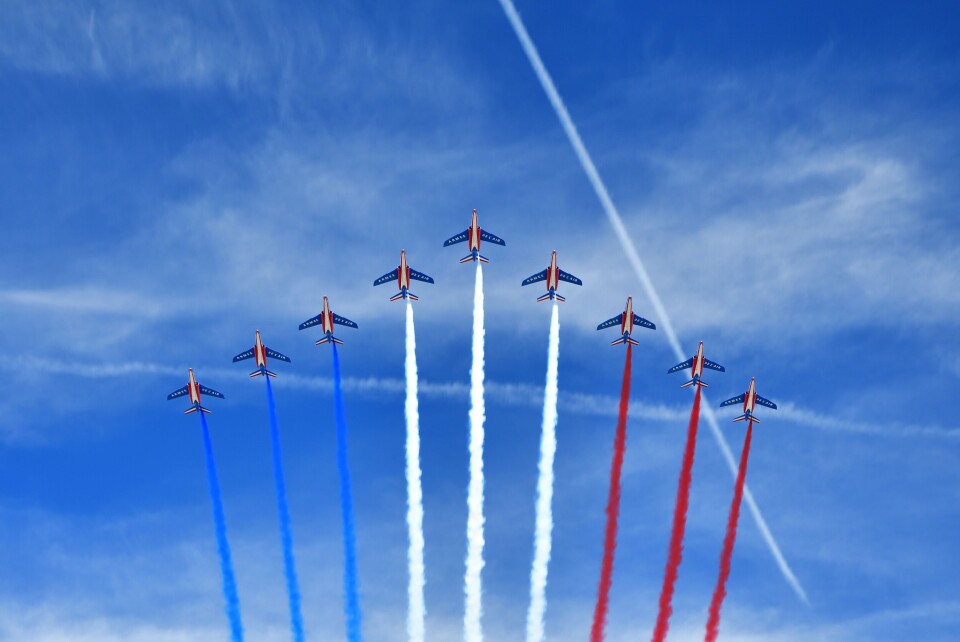
Paris’ military parade typically sees a performance from the French version of the Red Arrows
noriox / Shutterstock
Tuesday (July 14) is a public holiday in France as the country pauses to celebrate its national day.
The event is seen as a celebration of France, especially the Republic. It is a concept perhaps alien to Britons but not Americans who are fresh from toasting their independence earlier this month.
The most important thing for English-speakers to remember is not to call it Bastille Day. This is an anglicism. In France, the day is called la fête nationale or le 14 (quatorze) juillet.
The date has been a national holiday since 1880 when author Victor Hugo helped bring about a law to enshrine the day as a symbol of French liberty.
For some, it is as much a symbol of France as the tricolour flag or the national anthem, La Marseillaise.
What does it celebrate?
The date is tied to the French Revolution, which some say began on July 14, 1789.
With increasing national debt, a gulf in living conditions between rich and poor and a ruler unwilling to listen to the demands of the people, tensions were at breaking point towards the end of the 18th Century.
King Louis XVI called the ‘Estates General’ – consisting of representatives of the nobility, clergy, and the ‘third estate’ (everyone else) – to his palace in Versailles to calm matters.
Royal troops moved from Paris to Versailles for the meeting, leaving Paris with few defences. Parisians angry over the dismissal of a key minister on July 11 started a rebellious call to arms.
On July 14, a group of rebels sacked Les Invalides for its weapons and marched to the Bastille prison and armoury – which housed gunpowder supplies.
The prison’s governor shot at the advancing crowd, leading to a bloody battle. Although only a handful of prisoners were being held in the Bastille its capture from royal forces was seen as a symbolic victory.
One year later, in 1790, the storming of the Bastille was celebrated at the Fête de la Fédération, which also saw a group of national guards (a citizens’ militia) from across the country organise a march on the Champ de Mars.
A law passed in 1880 officially declared July 14 as France’s national day, but did not specify whether this was in reference to the events of 1789 or 1790.
What happens each July 14?
Aside from being a holiday for most working people (some shops remain open, and public transport is still running - but may end services earlier than usual), the day is known for its celebrations.
The most notable is the large military parade along the Champs-Élysées in Paris, where the French president makes an appearance.
This year the ceremony will begin at 9:50 (you can watch live on TF1 or France 2) and will feature 6,686 participants, 299 army vehicles, 90 planes, 32 helicopters and 193 horses. It typically lasts around 90 minutes.
Rarely, the parade takes a different path through Paris, such as in 1979 when soldiers paraded between Place de la Bastille and Place de la République.
The French president sometimes gives a speech on the day.
On the evenings of July 13 and July 14 firefighters hold a special ball at their fire stations, which are often family-friendly events you can bring your children to.
Small towns and rural villages also typically mark the occasion with communal meals shared around long trestle tables in the local square. This is often accompanied by live music, pétanque tournaments, and a dance (bal populaire).
Usually, towns and cities across France hold firework or drone displays to mark the day, although this year there have been several cancellations. This is a move to lower the risk of fires, with many departments in France facing drought and heatwave warnings.
In many places across France, including Paris, celebrations are being advanced to July 13 this year to respect the national commemoration marking the tenth anniversary of the 2016 Nice terror attack, in which 86 people were killed, including 15 children, and 458 were injured.
The victims’ commemoration ceremony will take place on July 14.