






news
More flexible citizenship rules for foreign retirees: see minister’s full reply to senator
Senator vows to monitor how new guidelines are applied by prefectures


Published
Modified


Following the promise of a more flexible approach to citizenship applications from foreign retirees – as we broke news of this week – seeing the minister’s original letter setting out the new guidelines could help those hoping to benefit from the changes
The Connexion first reported on foreign retirees being turned down for citizenship solely on grounds that their income came from abroad in June 2025 but more cases followed. We also highlighted Charente Senator Nicole Bonnefoy’s efforts to challenge this.
The issue originally arose due to a circular sent to prefectures by former Interior Minister Bruno Retailleau (click here on the PDF symbol to read it ), in which he said applications from people whose income was mostly from abroad should be refused because they have not sufficiently transferred their affairs to France.
He was replaced as interior minister by Laurent Nuñez in October 2025.
At the time the circular came into force, the ministry told The Connexion there had previously been a “goodwill measure” allowing those over 65 whose income was mainly from overseas sources to obtain citizenship, but this “tolerance” was removed by the circular, which made no distinction between workers and retirees.
The circular did, however, say exceptions could still be made but reports from readers and on social media soon revealed many examples where rejections were made on this one criterion.
Interior ministry figures later confirmed a fall in naturalisations in 2025, by 13.5%, which the ministry itself said on a website was linked to tougher citizenship rules in the circular.
Ms Bonnefoy (Charente, Parti Socialiste) who had been told of residents affected in her area, took the issue up with Mr Nuñez, starting with a parliamentary question in October 2025. In April 2026 the ministry promised to consider issuing more flexible guidelines.
Ms Bonnefoy wrote to Mr Nuñez in September noting she had yet to receive news of a change.
“Must I remind you that these people participate fully in local life and massively contribute to the promotion and attractiveness of our territories?” she asked, adding that “these [refusal] decisions, taken on a purely fiscal or administrative basis, do not reflect the reality of their integration, or the profound attachment they feel for our country, nor the real contribution that they bring to the life of our territories.”
She added: “Having been contacted locally by applicants feeling anxious over the lack of a response, I ask you to indicate what conclusions you plan to bring to this issue which is holding back people’s lives and some remarkable stories of integration.”
You can read more about the response she received in our article here, and see the original text below. This will be useful if you are considering a new application on the basis of these changes.
You may wish to draw attention to wording such as the fact Mr Nuñez said: “Les modalités d’examen des demandes de naturalisation des personnes retraitées ont été adaptées, afin de mieux tenir compte de la spécificité et de la diversité de leurs situations” [procedures for assessing applications for naturalisation from retired people have been adapted to take better account of the specific nature and diversity of their circumstances].
He also stressed the new importance that will be given to “un ancrage local fort” [strong local roots].
In a social media post this week Ms Bonnefoy said she had found the situation “profoundly unjust”, thanking the minister for his actions.
“These changes are an important advance and a recognition of the work done for over a year, notably through my repeated exchanges with the minister and his office,” she wrote.
“I am delighted that our efforts have been heard and that the human realities will henceforth be better accounted for.
“I will, however, remain vigilant as to the effective application of these guidelines in all prefectures and as to the re-examination of individual situations.
“Naturalisation must take account of attachment to our country, integration and the person’s life journey, not just where their pension comes from.
“It is a question of justice, of good sense and of gratitude towards those who have chosen to make France their country.”
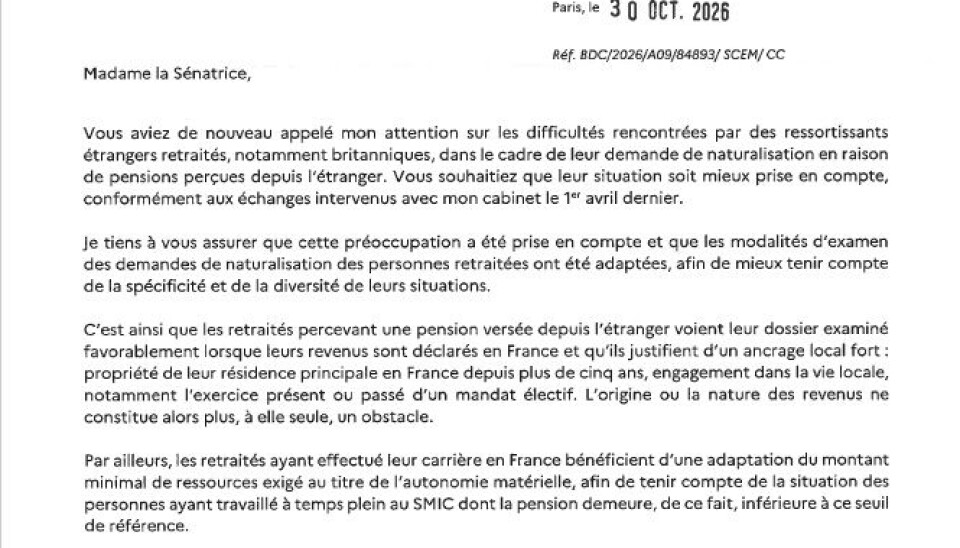
Translation:
You recently drew my attention again to the difficulties encountered by retired foreign nationals, particularly British nationals, when applying for naturalisation because they receive pensions from abroad. You wished their circumstances to be better taken into account, along the lines discussed with my office on April 1.
I would like to assure you that this concern has been taken into account and that the procedures for examining naturalisation applications from retired people have been adapted to better reflect the particular characteristics and diversity of their circumstances.
Thus, retired people receiving a pension from abroad now have their applications considered favourably when their income is declared in France and they can demonstrate strong local roots: ownership of their main home in France for more than five years, involvement in local community life, particularly through holding or having held elected office. The origin or nature of their income therefore no longer constitutes an obstacle in itself.
Furthermore, retired people who worked during their careers in France benefit from an adjustment to the minimum resources required to demonstrate financial independence, to take account of the situation of people who worked full-time on the minimum wage (SMIC) and whose pensions consequently remain below this reference threshold.
The implementation of these guidelines has already led the sub-directorate responsible for access to French nationality to give favourable consideration to several applications that had been awaiting checks or examination of an administrative appeal.


