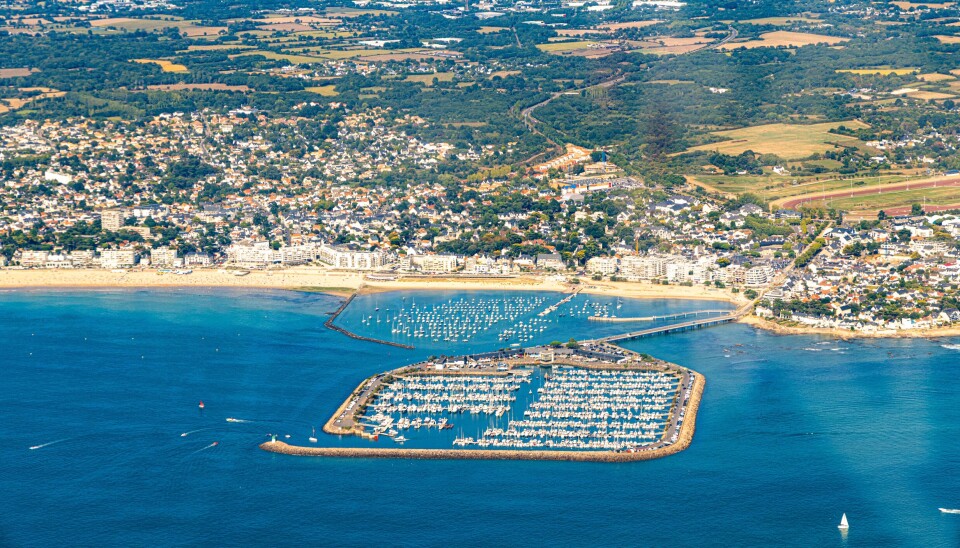
La Baule-Escoublac is a classic French case study in the evolution of the grand resort
The coastal town is renowned for its Belle Epoque villas, Art Deco elegance, and modernist designs
La Baule-Escoublac is home to a diverse range of seaside architecture and markets its work-life balance and appeal for a chic clienteleOlivier Malard/Shutterstock
La Baule-Escoublac (sometimes known simply as La Baule), located in the Pays de la Loire region, is an almost unique example of a French coastal town which built its own history and adapted its storytelling on the blending of various architectural styles.
Part of its legend is built on Belle Epoque villas, with Art Deco elegance and modernism colliding with regional touches such as neo-Basque gables, Norman half-timbering, and Breton granite.
Its post-World War Two construction schemes focused on apartment blocks, buildings in line with the Grand ensemble (collective housing) growth period and meant to democratise the seaside resorts.
Since being named a Site patrimonial remarquable (SPR, or remarkable heritage site) in 2018, the town has put the emphasis on it being a ‘ville-jardin’ (garden town) and markets its work-life balance appeal for a chic, middle-class clientele.
“La Baule showcases a diversity of styles, colours and forms that bear witness to the various eras that have shaped the resort’s history,” writes the town’s tourism office in its brochure, highlighting what they call ‘seaside architecture’.
La Baule-Escoublac is a Site patrimonial remarquableChristophe KLEBERT/Shutterstock
In the 19th Century, the area was neglected marshland, better known for shifting dunes than for leisure.
Settlement centered instead around Escoublac, a nearby village that had to relocate several times as the sands gradually encroached. The real turning point came with the arrival of the railway in 1879.
The village began to gain prominence as it slowly transformed into a hotspot of sea-bathing tourism, copying seaside towns such as Deauville, Biarritz, Royan, and Arcachon, which all capitalised on this new economy.
‘La Bôle’ means ‘marshy shore’ in the Breton dialectVernerie Yann/Shutterstock
Art Deco elegance
The Belle Époque saw increased building of villas, reflecting the ambitions of the wealthiest people from England and France.
During that period, architects Georges Lafont, André Chauvet and René Perrey built about half of the 15 villas now listed as Patrimoine exceptionnel.
The stylish Hôtel Barrière Le RoyalShutterstock/Vernerie Yann
Key villas include the villas Symbole (1881), Ker Vary (1896), Louisic (1906) and Pax (1908).
These villas – about 6,000 in total – are scattered throughout La Baule-Escoublac, particularly in the Grands Hôtels and La Baule-les-Pins districts.
As tourism increased, villas multiplied and the town invested in leisure infrastructure: tennis courts, golf courses, pigeon-shooting grounds, and equestrian centres.
New buildings then embraced Art Deco elegance, best incarnated by the Hôtel Barrière Le Royal with its geometric forms, curved lines and stylised ornamentation.
Post-war urbanism
After World War Two, La Baule-Escoublac experienced urban expansion to accommodate more visitors. Modernist architects favoured functionality, simplicity, and integration with the environment.
Residential blocks and some tourist facilities from this period feature large terraces, open layouts, and clean lines, reflecting changing ideas about leisure, light and air.
The Wave Building, known as ‘L’immeuble en Vague’, is the best example from that era. Designed by architect Pierre Doucet in 1979, the wavy facade embodies the late 20th-Century modernist aesthetic, characterised by its bold, sculptural form and innovative design.
‘L’Immeuble en Vague’ became the symbol of rampant urbanity, spreading right up to the beach. The building was part of many nicknamed the ‘Vagues de Mazy’ (Waves of Mazy), a name taken from the district where they are located.
Bold, sculptural 'wave' building design on the La Baule seafrontPack-Shot
“How do you find La Baule?” asked one journalist of a local woman in 1979.
“Ugly,” she answered.
One million tourists in summer 2025
Mass tourism did not affect La Baule’s economy, and the town continued to grow through the decades. The elite – such as actors Jean-Paul Belmondo and Gérard Lanvin, as well as actresses Judith Godrèche and Catherine Deneuve – kept on coming, and tourism skyrocketed, reaching close to one million tourists over the summer of 2025.
The town launched a major revision of its Site patrimonial remarquable following a municipal council decision in 2018. The review aimed to reassess the status of 6,000 villas, strengthen vegetation protection, guide future development and improve regulations.
A survey and analysis of all villas was carried out, identifying which buildings should be protected and highlighting areas where greenery could be enhanced. It has not been without consequences, with some architects lamenting the excessive regulations limiting construction, and legal disputes between neighbours.
For example, two of them have been fighting over a swimming pool permit for four years now, with one neighbour complaining it does not follow heritage preservation rules.
The municipality planted 400 trees in 2024, as part of a policy aimed at boosting biodiversity and enhancing the quality of life for residents and visitors alike.
La Baule-Escoublac was recently the centre of interest for political analyst Jérôme Fourquet and sociologist Jean-Laurent Cassely in their book La France sous nos Yeux (France Before our Eyes, Seuil, 2021).
Both noticed the town’s clearer marketing message in 2023: ‘Vivre et travailler au pays des vacances’ (Live and work in the country of holidays) which capitalised on the Covid period and the increase in remote working.