






news
Two-headed tortoise in Var named in online vote
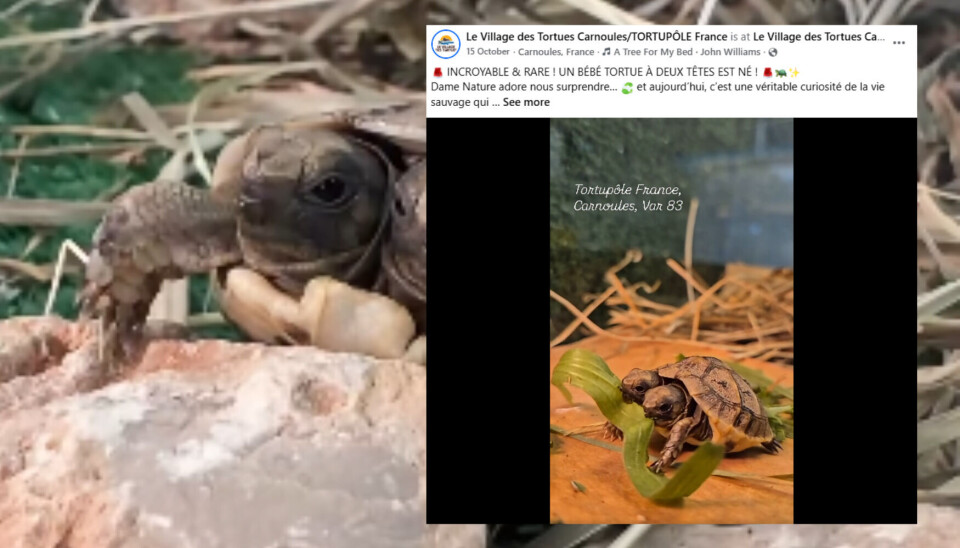
The young Testudo graeca has two heads but a single shell

Published


A baby tortoise born with two heads living at a sanctuary in Var has been christened after an online poll to name the animal.
The young Testudo graeca, which has two heads but a single shell, was ultimately named Chapi Chapo.
It was originally taken in by the Village des Tortues Carnoules/Tortupôle France in Carnoules in September.
Shortly after, the sanctuary invited online users to suggest names, drawing up a short list of 10 finalists.
These included Twix, Twin, Nous 2, Bee Bop, Mona-Lisa, Ding Dong and R2-D2.
A total of 921 people commented on their pick, with Chapi Chapo emerging as the winner.
The name is a reference to the French children's television series of the same name, featuring two characters, a boy and a girl.
“It's a nice coincidence: in this famous French series, there's a boy and a girl, which works out rather well because it’s too young to know its sex,” the sanctuary said.
The team also shared an update on the animal's health.
“Chapi Chapo is in excellent health! It eats very well and moves around perfectly, even if sometimes the agreement between Chapi and Chapo is not perfect,” it said.
The tortoise will be kept at the sanctuary’s veterinary unit and visitors will be able to see it, as well as other turtles, in the park.
In an earlier Facebook update, the team had also said that its digestion was going well and that it enjoyed eating young wild grass shoots.
It added that an X-ray would be carried out when possible to learn more about its anatomy and check that everything was functioning properly.
It is extremely rare for an animal to be born with two heads, although the phenomenon has been documented in several species, particularly reptiles.
The condition, known as bicephaly (or dicephaly), is thought to be caused by problems during the early stages of embryonic development.
While it would be hard for an animal with two heads to survive in the wild, with specialist care in captivity it is possible for them to live long lives.
A two-headed Greek tortoise at Geneva's Natural History Museum known as Janus, for example, has survived for more than 29 years.


