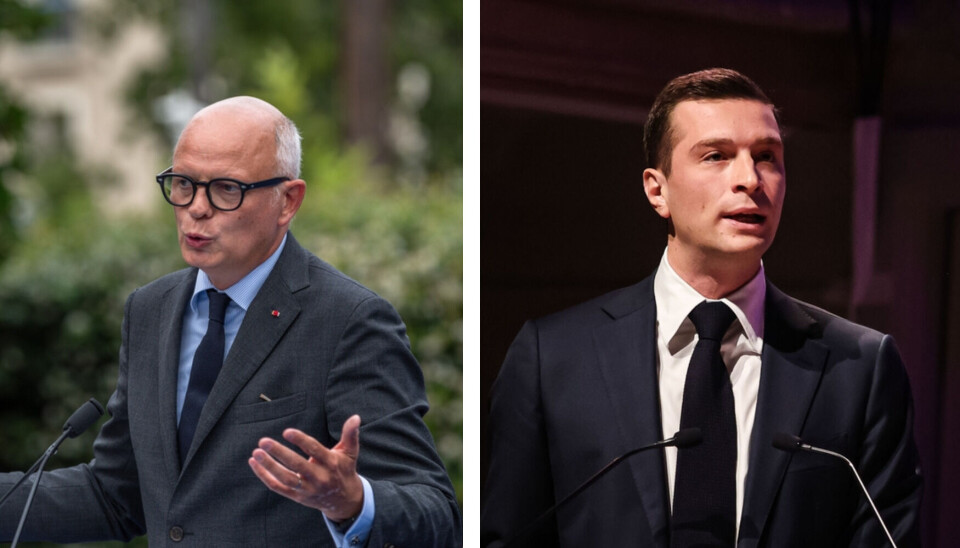
The far-right Rassemblement National would comfortably win the first round of a presidential election if it were held tomorrow, according to a new opinion poll.
The result saw 35% of the 1,500 poll respondents saying they would vote for the party’s leader Jordan Bardella as the next president, placing him well above the next highest candidate, former Prime Minister Edouard Philippe on 20.5%.
The poll saw several questions asked of respondents to assess their general voting intentions as well as who would win in hypothetical second-round run-offs.
However, it is worth noting that 15% of respondents had no overall opinion on any of the given candidates.
The graphic below shows the full results of the poll for first-round intentions.
As a reminder, the presidential election is set to take place in April 2027.
If no candidate receives an absolute majority (50% or more) of all votes cast in a first round, then a run-off is held two weeks later with only the top two candidates going through.
President Emmanuel Macron cannot run as the constitution only allows for two consecutive terms.
Legislative elections to return MPs – and, all parties hope, break the current deadlock in the Assemblée nationale – are expected to be called soon after, although legally the current Assemblée does not need to be dissolved until 2029 following the snap elections in July 2024.
Poll leaves several questions unanswered
Despite the resounding victory implied for the RN, and their success in 66 mid-sized communes inthe municipal elections several elements of the poll can be questioned.
If overturned, she – and the party hierarchy including Mr Bardella – are adamant she would be the RN candidate, with Mr Bardella primed to take the prime ministerial position in any ensuing legislative victory.
The only candidate confirmed to be running is Edouard Philippe, who stated he would campaign provided he was re-elected as mayor of Le Havre, a feat he achieved in the 2026 municipal elections.
Polls for a second round contest between Mr Philippe and a RN candidate – Mrs Le Pen or Mr Bardella – show a tight contest, with Mr Philippe narrowly victorious.
Bruno Retailleau of Les Républicains announced his intention to run as the party’s candidate, but may face an internal primary campaign from his opponents, and there are calls from both the centre-right and parties elsewhere on the right for a wider ‘inclusive right’ candidate.
Several other questions persist:
Will the other centrist parties unite behind Mr Philippe?
It is possible that Macronist candidates including Gabriel Attal (also a former prime minister) could launch their own bids, following criticism of President Macron by Mr Philippe and his Horizons party.
Having too many candidates in the field risks splitting the vote, however, reducing the chance of one reaching the second round.
Centrists, particularly those from Mr Macron’s Renaissance party, are unlikely to formally ally with any other group in the first round of the election, but will probably point voters towards a certain candidate in the run-off.
Will there be a repeat of the alliance of the Greens, Socialists, and Communists?
Such an alliance was formed for the recent 2026 municipal elections and saw mayoral victories in many of France’s major cities including the three biggest: Paris, Marseille, and Lyon.
A united left or centre-left alliance could galvanise voters behind a candidate, however questions persist over whether the parties could agree to back a single candidate for the first round.
In the above poll, uniting the votes from the three parties would still see the alliance finish third, behind Mr Philippe and Mr Bardella.
Leftist – and some centrist – voters may be tempted to back a coalition candidate from the Socialists/Greens/Communists if they believe there is a good chance of them making the second round, where a call for a ‘Republican Front’ against the RN could induce more varied voters to block the far-right and elected a left-wing president.
Centrists, right-wingers and far-left voters may be more likely to vote for a soft-left candidate in the second round as part of an anti-far-right coalition, but a second-round candidate from any of these groups may alienate one another (for example, right-wingers will not vote for a La France Insoumise candidate and vice versa, even against the RN).
How will the far-left influence the election?
The far-left La France Insoumise is also polling above 10%, but following a series of controversies and fall outs with other parties on the left of the chamber, a wider ‘Front Populaire’ between them and the other left-wing parties is extremely unlikely.
The party has a history of performing well above initial expectations in recent elections (in both 2017 and 2022, Jean-Luc Mélenchon received more than 19% of the presidential vote, narrowly missing out on the second round) but may have run out of steam this time around.
Centrist MPs have, since the 2024 legislatures, where some element of ‘Republican Front’ against the far-right saw the groups work together, often demonised La France Insoumise and describe them as being as extreme as the RN.
They explicitly state they will not work in an anti-far-right alliance with La France Insoumise, and following the breakdown of the former Nouveau Front Populaire alliance between the far-left and leftist groups, several Socialists, Greens, and Communists have said the same.
This includes Raphaël Glucksmann, Socialist MEP who appears likely to lead the party into the 2027 presidential campaign.
Some informal alliances between the far-left and left were formed in the 2026 municipals, but led to defeat in major cities such as Toulouse, further strengthening claims from the left that far-left alliances leech more votes than they gain.
Will far-right unite? Will the RN collapse under expectations?
Mr Bardella is well ahead of all other candidates in the polls, and RN leaders may even be privately considering the possibility of a first-round victory – unseen so far in the Fifth Republic.
This would require taking the vote share from essentially all other right-wing parties, and require those to the right of Les Républicains to officially endorse the RN.
Firebrand Eric Zemmour led a disappointing presidential campaign in 2022 for the Reconquête party, which saw him fall below initial expectations.
Director of his campaign Sarah Knafo received more than 10% of the vote share in the first round in the recent Paris municipal elections, showing that even with controversial views on immigration (the party openly supports the Great Replacement conspiracy) a pro-business economic agenda can be popular in metropolitan areas.
Ultimately, the parties differ considerably on economic outlook – the RN is largely protectionist and claims that it will not cut benefits or implement austerity measures – and this may prevent any formal alliance.
The RN will also have memories of the 2024 legislative election.
A strong showing in the first round saw many, including the media, believe the party were on course to dominate in the second round, potentially even receiving a majority.
However, a web of loose alliances between the centrists, Socialists, Greens, and far-left to block the far-right vote saw the Nouveau Front Populaire come out on top and the centrists retain many seats.
While the potential for such a ‘Republican Front’ seems diminished, the memory of cameras capturing disappointment at RN headquarters around France lives fresh in the memory.